Recently, I came across the term “reap” while chatting with a friend. At first, I had no idea what it meant.
The word suddenly appeared in the conversation, and I found myself wondering, “Am I missing something here?”
I didn’t want to misunderstand the message or respond the wrong way, so I decided to look deeper into the reap meaning in the Bible.
The more I studied it, the more I realized that this simple word carries a powerful biblical message.
In Scripture, “reap” is often connected to harvest, rewards, consequences, and the results of our actions. It teaches important lessons about faith, obedience, and God’s justice.
Many people encounter biblical terms like this in conversations, social media posts, devotionals, or Bible studies without fully understanding them. Learning their meaning can help us grow in faith and better understand God’s Word.
After discovering the biblical meaning of reap, I felt much more confident and informed. More importantly, I gained a deeper appreciation for the spiritual truths hidden within this powerful word.
So, what does reap mean in the Bible, and what spiritual lessons does it hold for believers today? Let’s explore its meaning and significance through the lens of Scripture.
Biblical Meaning of “You Reap What You Sow”
The clearest Bible verse for this teaching is found in Galatians 6:7:
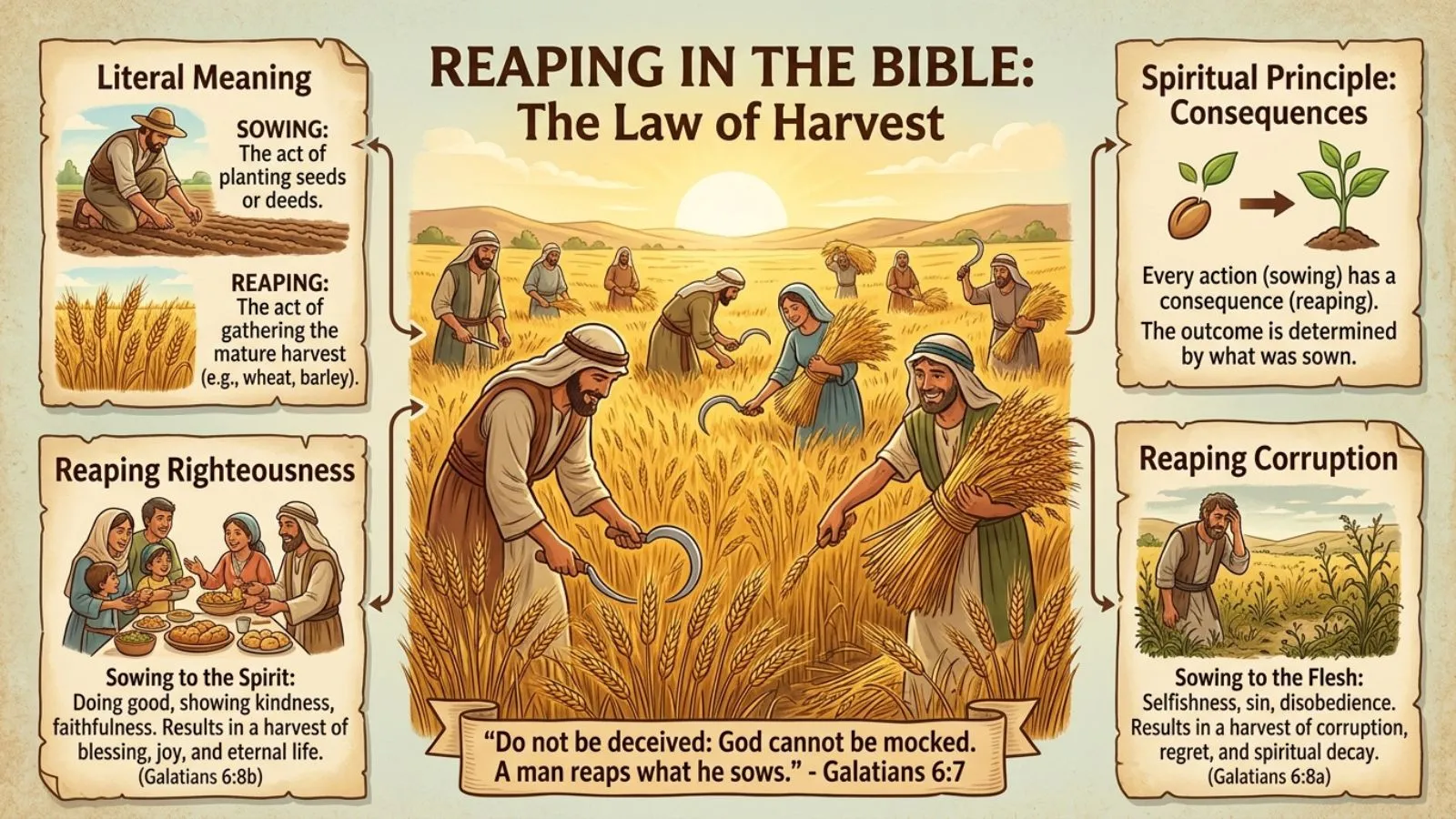
“Do not be deceived: God is not mocked. A man reaps what he sows.”
This verse is very direct. It means that life has spiritual laws, and one of them is the law of sowing and reaping. Just like a farmer cannot plant wheat and expect corn, our actions produce results that match what we put into the world.
If someone sows kindness, they often receive kindness in return. If someone sows dishonesty or harm, they may eventually face consequences tied to those actions.
Another important verse is 2 Corinthians 9:6:
“Whoever sows sparingly will also reap sparingly, and whoever sows generously will also reap generously.”
This verse adds another layer of meaning. It shows that the size of our “harvest” depends on how we live. A generous heart leads to a generous life. A closed heart often leads to lack and emptiness.
In the Old Testament, we also see this principle. Hosea 8:7 says:
“They sow the wind and reap the whirlwind.”
This shows a warning. When people live in sin or ignore God, the results can become stronger and more painful than expected.
But this teaching is not only about punishment. It is also about growth, wisdom, and grace. God uses this principle to guide us toward better choices. He wants us to understand that every action matters.
Spiritually, “you reap what you sow” means:
- Your choices shape your future
- Your heart condition affects your outcomes
- God’s justice and timing are always at work
- Good seeds lead to good spiritual harvest
God is not trying to scare us. He is teaching us how life works so we can walk in wisdom and peace.
Spiritual Significance and Symbolism
On a deeper level, you reap what you sow meaning in the Bible is about the condition of the heart.
Every thought, word, and action is like a seed. When we speak love, we plant love. When we choose forgiveness, we plant peace. When we stay in prayer, we plant faith.
Jesus also taught this idea through His parables. He often spoke about seeds, soil, and harvest to explain how the Kingdom of God works. The seed represents the Word of God, and the soil represents our heart.
This means that spiritual growth depends on what we allow to grow inside us.
If we plant:
- Faith, we grow strength in God
- Prayer, we grow connection with Him
- Love, we grow peace in relationships
- Sin or bitterness, we grow distance and pain
But the beautiful truth is this: God always gives us a chance to plant new seeds. No matter what was planted in the past, today can be a new beginning.
In daily life, this can be seen in simple ways. A person who shows patience often experiences calmer relationships. A person who gives encouragement often receives support when they need it most.
Spiritually, this principle reminds us that God is always watching over our growth. He cares about what we are becoming, not just what we are facing today.
So, this message is not only about consequences. It is about transformation and spiritual awakening.
Biblical Interpretations in Dreams or Real Life
Many people also connect you reap what you sow meaning in the Bible to dreams or real-life situations.
In dreams, seeing seeds, farming, or harvest can symbolize what is happening in your spiritual life. A healthy field may represent peace and growth. A dry or empty field may represent spiritual struggle or neglect.
In real life, this principle can appear in many ways:
- If you sow peace in relationships, you may experience harmony
- If you sow anger or hurt, conflicts may grow
- If you sow faith through prayer, you may see answers and guidance
Sometimes, people go through difficult seasons and feel confused. But the Bible reminds us that not every hardship is punishment. Some challenges are part of growth, correction, or preparation for something better.
A stormy “harvest” season may feel painful, but it can lead to spiritual maturity. A peaceful season may reflect God’s blessing and alignment in your life.
The key is to stay close to God in every season. Prayer helps us understand what we are experiencing and how to respond with wisdom.
Practical Lessons & Faith Insights
The message of you reap what you sow meaning in the Bible teaches us to live carefully and faithfully. Every small choice matters.
It encourages us to:
- Sow kindness even when it is hard
- Stay faithful in prayer and trust God’s timing
- Choose forgiveness instead of bitterness
- Live with honesty and love
When we plant good seeds daily, we build a life that reflects God’s light.
Conclusion
The Bible’s message of you reap what you sow is both a warning and a blessing. It reminds us that life responds to our actions, but it also assures us that God rewards faith, love, and obedience.
Every seed you plant today becomes part of your tomorrow. Choose wisely, walk in faith, and trust God with the harvest.
Even in uncertain times, God is still guiding your journey, turning every seed into His perfect plan.