Have you ever wondered why the Bible mentions a place where God’s people found safety, provision, and protection during a time of great trouble?
Hey, I want to share something that happened to me recently about Goshen in the Bible.
I was chatting with a friend when I suddenly saw this term pop up, and honestly, I had no clue what it meant at first.
I kept wondering, “Am I missing something here?” It was a bit confusing, and I didn’t want to respond the wrong way.
So, I decided to look into Goshen in the Bible meaning and understand its biblical context.
After learning about it, I realized that Goshen is more than just the name of an ancient place.
In Scripture, it became a significant place where the Israelites lived, grew, and experienced God’s provision and protection in Egypt.
Understanding its story helped me see why Goshen continues to carry an important spiritual message for believers today.
Now, whenever I come across Goshen in the Bible, I understand its meaning more clearly and can appreciate the deeper lesson behind this biblical place.
Biblical Meaning of Goshen
What Was Goshen in the Bible?
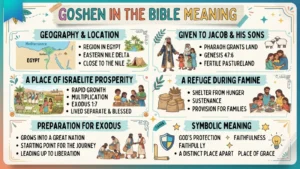
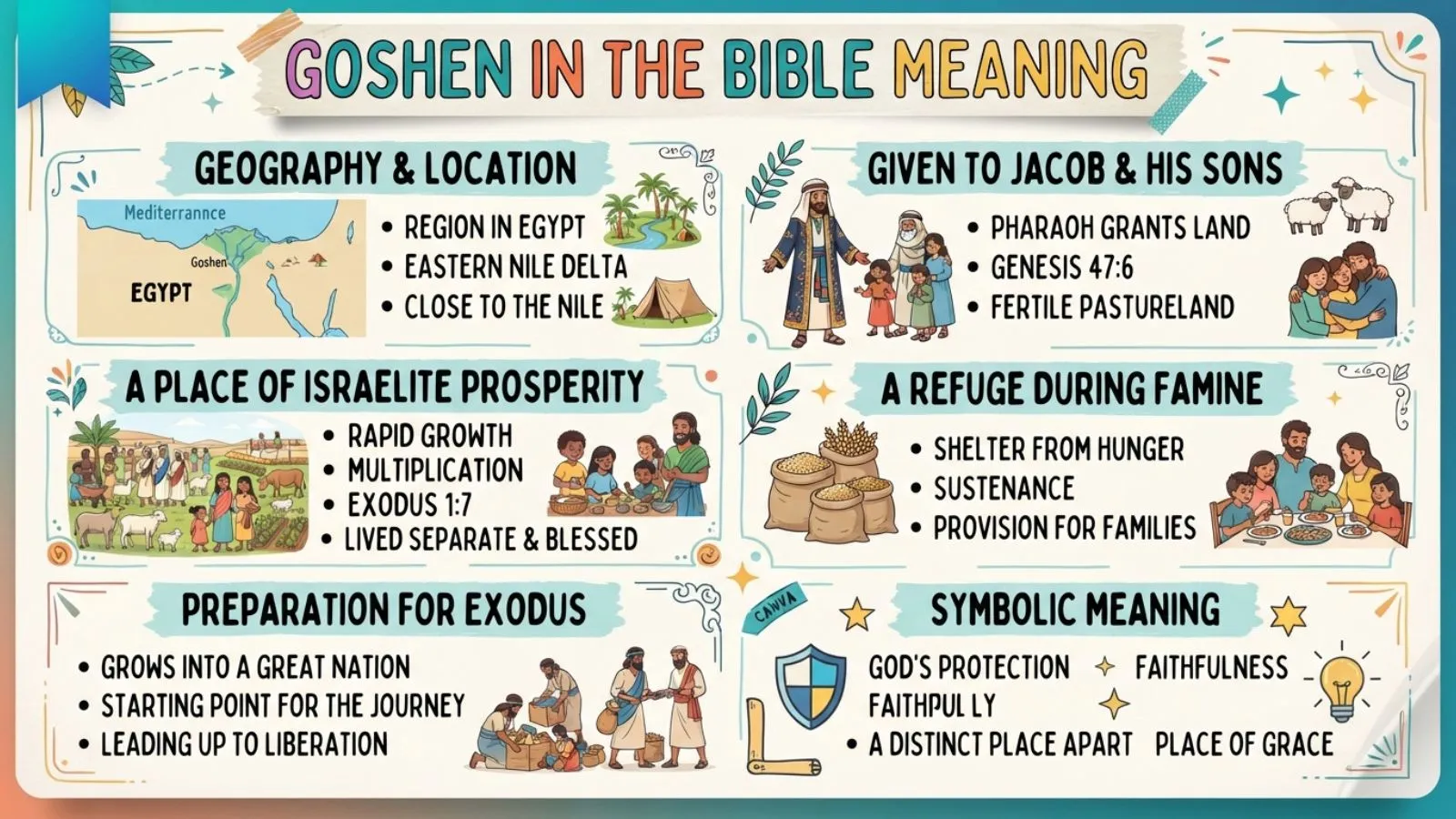
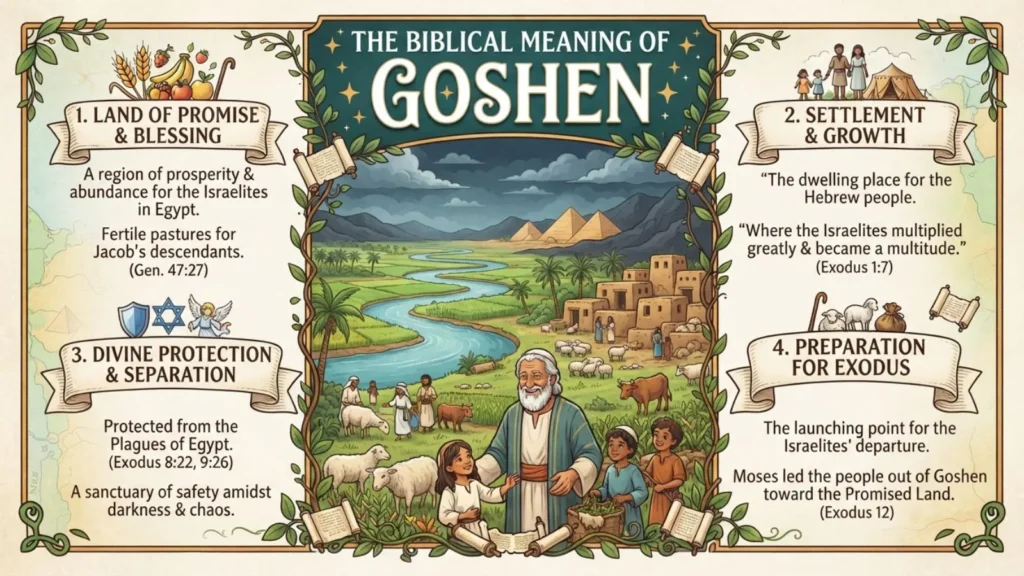
Goshen was a region in Egypt where Jacob and his descendants lived. When Joseph’s family came to Egypt because of the famine, Pharaoh allowed them to settle there.
Genesis 47:11 says that Joseph settled his father and brothers in the land of Egypt and gave them property in the land of Rameses, as Pharaoh had commanded.
Goshen became a home for Jacob’s family. They could live there, raise their families, and continue to grow.
This gives Goshen an important biblical picture: God can provide a place of safety and care during difficult seasons.
The family had left Canaan because of famine. They were facing uncertainty, but God had already prepared a way for them through Joseph.
Goshen Represents God’s Provision
One of the strongest themes connected with Goshen is provision.
Genesis 47:12 tells us that Joseph provided food for his father, his brothers, and their households. During a severe famine, God used Joseph’s position in Egypt to preserve his family.
This teaches an important Christian lesson. Sometimes God’s provision does not come in the way we expect. He may prepare the answer years before we understand why certain events are happening.
Joseph’s journey is a powerful example. He experienced betrayal, slavery, and imprisonment before becoming a leader in Egypt. Yet God used his difficult journey to save many lives.
Goshen reminds believers that God can provide even during seasons of lack.
Goshen Represents Protection
Goshen also became associated with divine protection.
During the plagues of Egypt, God made a distinction between His people and the Egyptians. In Exodus 8:22, God said that He would set apart the land of Goshen, where His people lived, so that certain plagues would not affect them.
Exodus 9:26 also says that in the land of Goshen, where the Israelites were, there was no hail.
This does not mean that believers will never experience trouble. Rather, the story shows that God is able to protect His people according to His will.
When life feels uncertain, Goshen can remind us to place our confidence in God’s care instead of fear.
Goshen Represents Separation
Another part of Goshen’s biblical symbolism is separation.
God distinguished Goshen from the surrounding Egyptian land during the plagues. This separation showed that His people belonged to Him.
For Christians, this can point to the idea of living with a different purpose. Romans 12:2 encourages believers not to be conformed to the pattern of this world but to be transformed by the renewing of their minds.
The lesson is not that Christians should avoid everyone around them. Instead, it is a call to remain faithful to God while living in the world.
Goshen can therefore represent a life that is set apart for God’s purposes.
Goshen Represents Hope During Hard Times
The Israelites lived in Egypt for many years. Their story eventually became one of oppression and suffering. Yet God did not forget them.
Exodus 2:23–25 tells us that God heard their cries and remembered His covenant with Abraham, Isaac, and Jacob.
This is one of the most comforting lessons in the story.
God’s silence does not mean God’s absence.
There may be seasons when you pray and wonder why nothing seems to change. The story of Goshen reminds us that God sees His people and remains faithful to His promises.
Spiritual Significance and Symbolism of Goshen
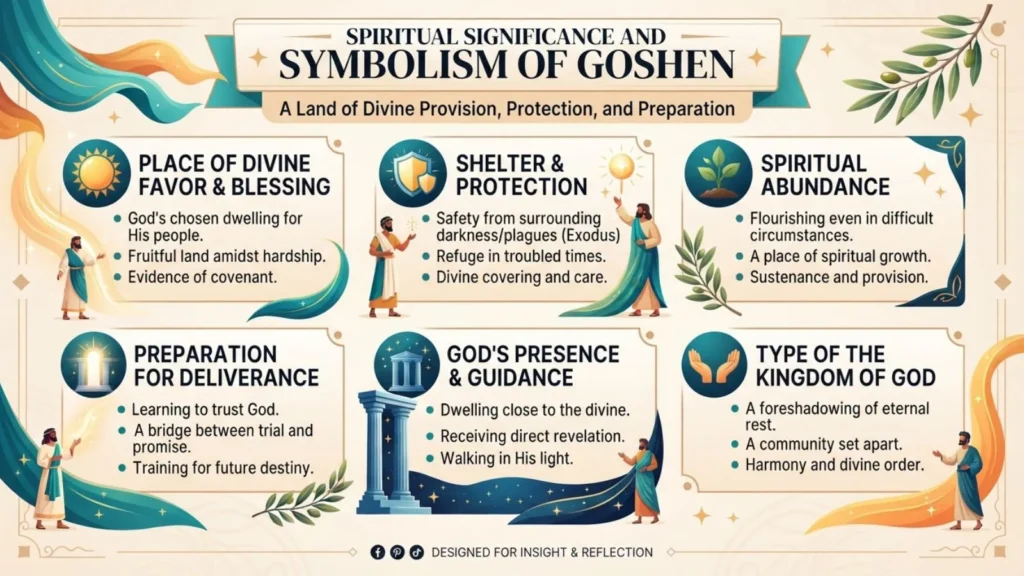
The spiritual symbolism of Goshen can speak to several parts of a Christian’s faith journey.
1. A Place of God’s Care
Goshen can remind you that God knows what you need.
Matthew 6:31–32 teaches believers not to live in constant worry about food, clothing, and daily needs. Jesus reminds us that our heavenly Father knows what we need.
Goshen gives this truth a picture. God provided for Jacob’s family when famine covered the land.
2. A Reminder to Trust God’s Timing
Joseph did not understand his entire journey when he was betrayed by his brothers. But years later, he could see how God had used those events.
Genesis 50:20 gives one of the clearest lessons from Joseph’s life: what others meant for evil, God could use for good.
Your current season may not make sense either.
You may be waiting for a job, healing in a relationship, direction, or a new beginning. Goshen reminds you that God can be working before you see the answer.
3. A Picture of Spiritual Refuge
Goshen can also remind Christians of finding refuge in God.
Psalm 46:1 says that God is our refuge and strength, an ever-present help in trouble.
A physical place cannot replace God. The deeper Christian lesson is that God Himself is our true refuge.
When your heart feels restless, prayer can become your place of peace.
4. A Symbol of Faithful Growth
Jacob’s family entered Egypt as a small family group, but their descendants eventually became a large nation.
Exodus 1:7 says the Israelites were fruitful, multiplied, and became exceedingly strong.
This shows how God can bring growth from small beginnings.
You may feel that your faith is weak today. But spiritual growth often happens slowly. Through prayer, Scripture, obedience, and trust, God can strengthen you over time.
Goshen in Dreams or Real Life

What if you see Goshen in a dream?
The Bible does not give a fixed rule saying that dreaming about Goshen always means one specific thing. Christian dream interpretation should therefore be approached with prayer, wisdom, and Scripture, rather than fear.
If Goshen appears in a peaceful dream, you might reflect on themes such as safety, provision, peace, and God’s care.
If the dream involves famine or hunger, it may encourage you to trust God during a season when you feel something is missing.
If the dream includes danger outside Goshen, it may remind you of God’s protection and your need to seek Him during uncertainty.
If you are leaving Goshen, you might reflect on the Israelites’ journey from Egypt toward freedom. It could simply encourage personal reflection about change, growth, or a new season.
However, not every dream is a divine message. Ecclesiastes 5:3 notes that dreams can come from many thoughts and concerns. Always compare spiritual impressions with God’s Word.
Practical Lessons & Faith of Goshen

Goshen teaches us to trust God’s provision, protection, and timing. When life feels uncertain, pray instead of allowing fear to control your heart.
Remember how God cared for Jacob’s family during famine and remained faithful to His promises. Ask God for wisdom, stay close to Scripture, and trust Him one step at a time.
Conclusion
The Goshen in the Bible meaning points to powerful themes of provision, protection, separation, hope, and God’s faithfulness.
Goshen was a real place, but its story gives Christians a beautiful reminder that God can care for His people during difficult seasons.
When you feel uncertain, remember that God sees you, knows your needs, and can guide your steps. Keep trusting Him, even when you cannot yet see where the journey leads.
Continue Reding:
- Biblical Meaning of Number 4: Faith, Creation, and Spiritual Significance
- Humble in the Bible: Meaning, Symbolism, and Spiritual Lessons
- Lowly in Scripture: Humility, Honour, and God’s Presence