Have you ever come across a Bible word that seems simple at first but carries a deeper spiritual message?
Rhema is one of those words, and understanding its biblical meaning can help you see how God’s Word speaks personally to your life.
I was chatting with a friend when I suddenly saw the term “Rhema” pop up, and honestly, I had no clue what it meant at first.
I kept wondering, “Am I missing something here?” It was a bit confusing, and I didn’t want to respond the wrong way.
So, I decided to look into Rhema Bible meaning and understand its biblical context.
After learning about it, I realized that rhema is often connected with a spoken or living word that brings God’s message into a specific moment or situation.
Understanding this meaning helped me feel more confident whenever I came across the term in Christian conversations, Bible studies, or social media.
Biblical Meaning of Rhema
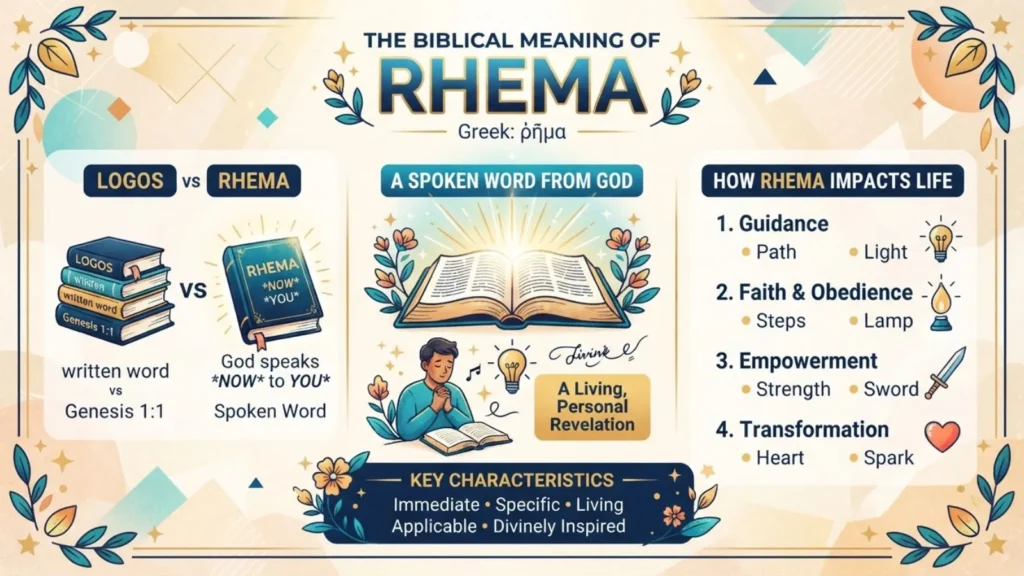
The Greek word rhema (ῥῆμα) can mean a spoken word, saying, statement, or utterance. The New Testament uses this word in different contexts.
For example, in Luke 1:38, Mary responds to the angel by saying, “Let it be to me according to your word.” The word translated as “word” is related to rhema. Mary received God’s message with humility and faith.
Another important passage is Romans 10:17:
“So then faith comes by hearing, and hearing by the word of Christ.”
Here, the Greek text uses rhema. The verse connects God’s word with hearing and faith. God’s truth gives believers a foundation for trusting Him.
Rhema and God’s Word
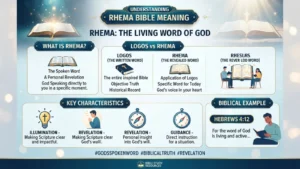
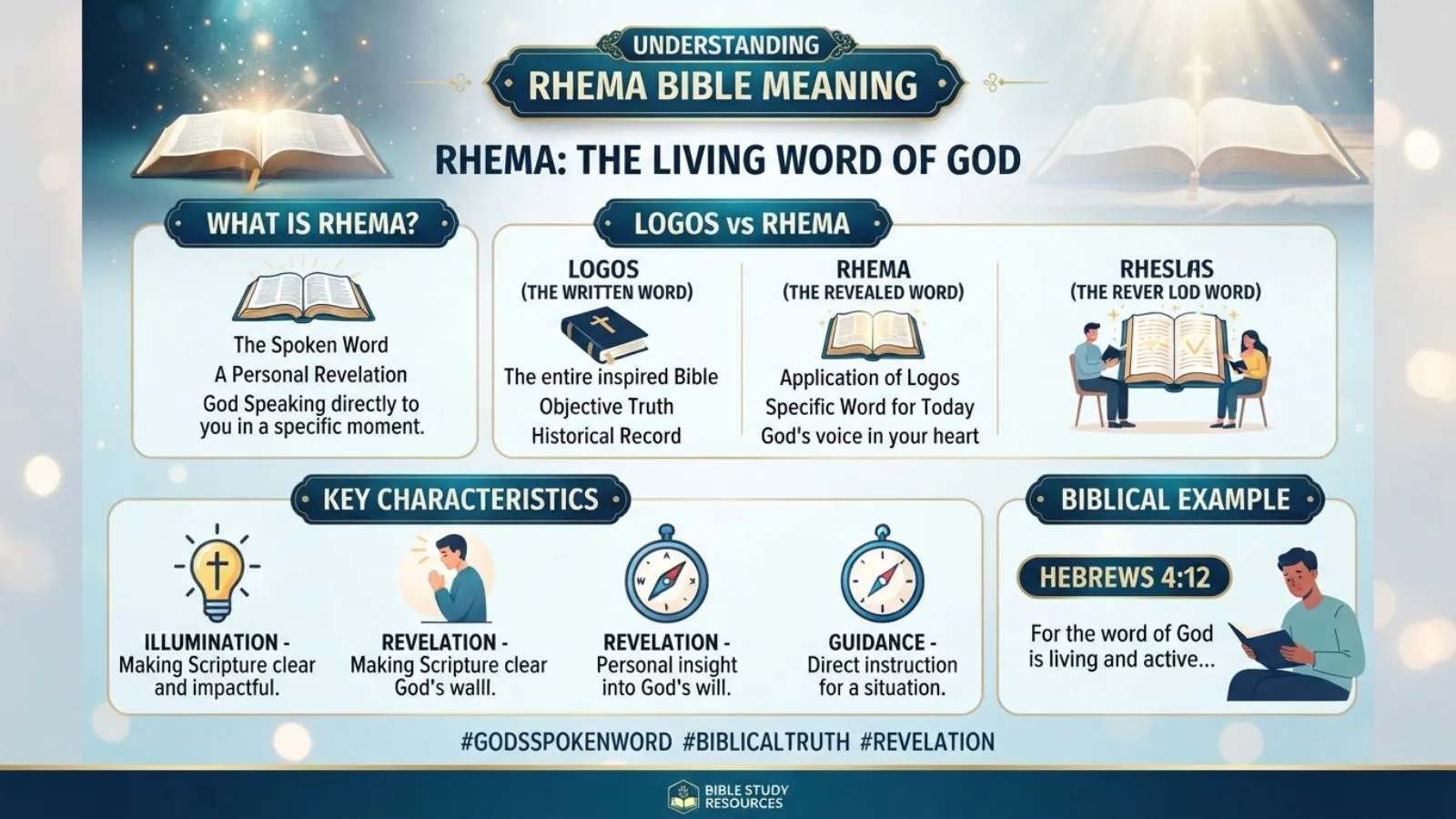
Many Christians explain rhema as a specific word or message that speaks into a person’s current situation.
For example, imagine someone is afraid about tomorrow. While reading the Bible, they come across Isaiah 41:10:
“Fear not, for I am with you.”
The verse may suddenly become very personal and comforting. The believer remembers that God is present and does not need to face the future alone.
This does not mean the verse was secretly rewritten for that person. Rather, God’s written Word brings truth, comfort, and direction to a real-life need.
The broader Greek word logos can also mean “word” and is used in Scripture for God’s message, teaching, or Word. Christians sometimes make a strict distinction between logos and rhema, saying that logos is the written Word and rhema is a personal spoken word. While this distinction can be helpful for teaching, the New Testament does not always use the two words in such a simple or rigid way.
The safest Christian understanding is that God’s guidance must remain rooted in His revealed Word.
Rhema Can Strengthen Faith
One of the strongest spiritual ideas connected with rhema is faith.
When God’s truth reaches your heart during a difficult moment, it can help you keep trusting Him.
Consider Matthew 4:4, where Jesus says:
“Man shall not live by bread alone, but by every word that comes from the mouth of God.”
Jesus was responding to temptation in the wilderness. He showed that God’s Word is essential for spiritual life.
This also connects with Ephesians 6:17, which describes “the sword of the Spirit” as the word of God. Scripture gives believers truth to stand on when fear, temptation, doubt, or discouragement comes.
A rhema message, then, should never lead you away from biblical truth. Instead, it should help you remember, understand, and apply God’s truth.
Rhema Can Bring Comfort
Sometimes the most powerful word is the one that gives peace.
When you feel alone, Hebrews 13:5 reminds believers that God will never leave nor forsake them.
When you feel anxious, Philippians 4:6–7 teaches believers to bring their worries to God through prayer.
When you feel weak, 2 Corinthians 12:9 reminds us that God’s grace is sufficient.
These verses can become deeply meaningful during different seasons of life.
The spiritual message is not simply, “This verse makes me feel better.” It is deeper: God’s truth gives you something solid to trust when your emotions change.
Rhema Can Also Bring Correction
A word from God is not always comforting.
Sometimes Scripture challenges us.
Hebrews 4:12 teaches that God’s Word is living and active and able to expose the thoughts and intentions of the heart.
You may read a passage and realize that you need to forgive someone, change a habit, speak truth, or return to prayer.
This kind of spiritual awakening may feel uncomfortable, but it can lead to transformation.
God’s Word does not only tell us what we want to hear. It also helps us become the people He calls us to be.
Spiritual Significance and Symbolism of Rhema
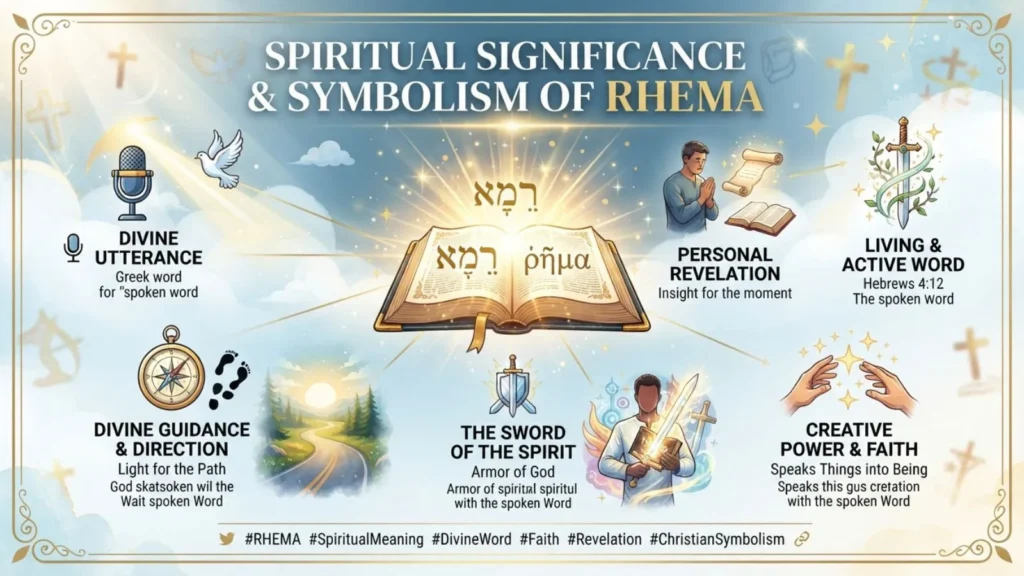
The spiritual symbolism of rhema centers on God’s truth becoming active in your daily life.
Imagine walking through a dark room with a small lamp. The lamp does not remove the entire journey, but it gives you enough light to take the next step.
In a similar way, Scripture can give you the light you need for the season you are facing.
Psalm 119:105 says:
“Your word is a lamp to my feet and a light to my path.”
A rhema experience may remind you that God has not forgotten you.
Rhema and Spiritual Growth
God’s Word can meet you at different stages of your journey.
A verse that encouraged you five years ago may speak differently to you today. The Scripture has not changed, but your situation has.
For example, Jeremiah 29:11 may encourage someone who feels uncertain about the future. Psalm 23 may bring comfort to someone walking through loss or fear. Proverbs 3:5–6 may guide someone facing a difficult decision.
The power is not in treating a verse like a magical sign. The power is in trusting the God who gave the Word.
Rhema and Prayer
Prayer is also important when seeking spiritual guidance.
Instead of asking only, “What does this verse mean for me?” ask:
“Lord, what are You teaching me through Your Word?”
Take time to read the passage in context. Pray about it. Think about its meaning. Compare your understanding with the rest of Scripture.
This helps protect you from confusing personal feelings with God’s voice.
Rhema in Dreams or Real Life

People sometimes connect rhema with dreams, repeated Bible verses, sermons, conversations, or moments during prayer.
For example, you may dream about a Bible verse or repeatedly notice the same passage. You may hear a sermon that speaks directly to a struggle you are facing.
These experiences can encourage reflection, but dream interpretation should remain grounded in Scripture.
Not every dream is a divine message, and not every repeated thought is a rhema word from God.
If something seems spiritually important, pray about it and test it against biblical truth. 1 John 4:1 encourages believers to test spiritual claims rather than accepting everything without discernment.
A genuine biblical message will not encourage sin, pride, hatred, fear-driven decisions, or anything that contradicts God’s Word.
Instead, it should point you toward faith, wisdom, obedience, love, and a deeper relationship with God.
Practical Lessons & Faith of Rhema
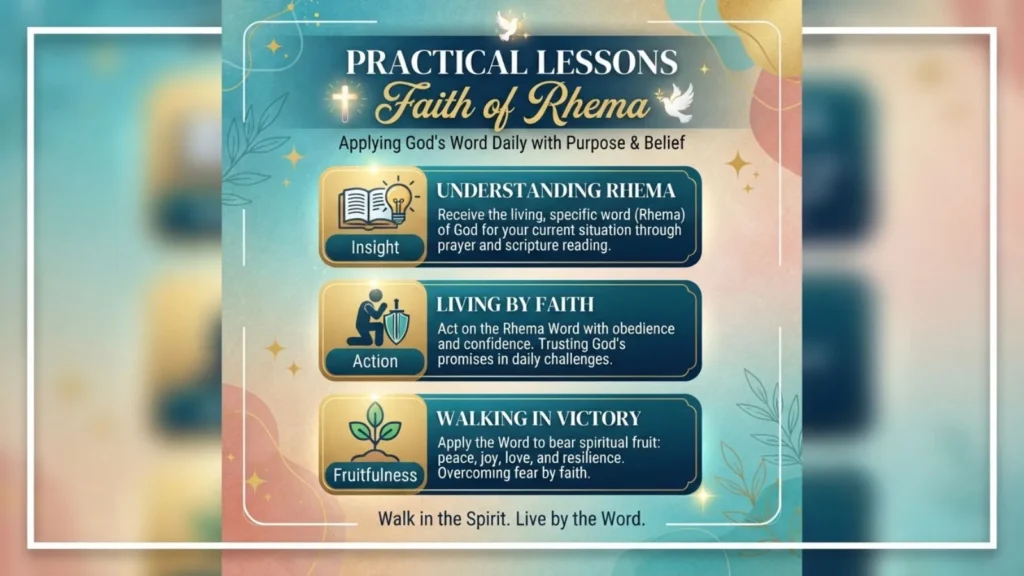
When you believe a Bible verse has spoken deeply to you, pause and pray.
Read it in context. Think about what God is teaching you. Test your understanding with Scripture. Do not rush into major decisions based only on a feeling.
Let God’s Word shape your heart over time. Seek wise Christian counsel when needed, and trust God’s timing.
Conclusion
The rhema Bible meaning is connected with a spoken word, saying, or message, and Christians often use it to describe how God’s Word becomes personally meaningful in a specific moment.
Rhema can bring faith, comfort, correction, wisdom, and hope. Yet true spiritual guidance should always agree with Scripture.
When a Bible verse speaks deeply to your heart, do not simply chase the experience. Seek the God behind the Word. Pray, listen, study, and trust Him to guide your steps.
Continue Reading:
- Goshen in the Bible: Symbolism, Blessings, and Spiritual Lessons
- Biblical Meaning of Number 4: Faith, Creation, and Spiritual Significance
- Humble in the Bible: Meaning, Symbolism, and Spiritual Lessons