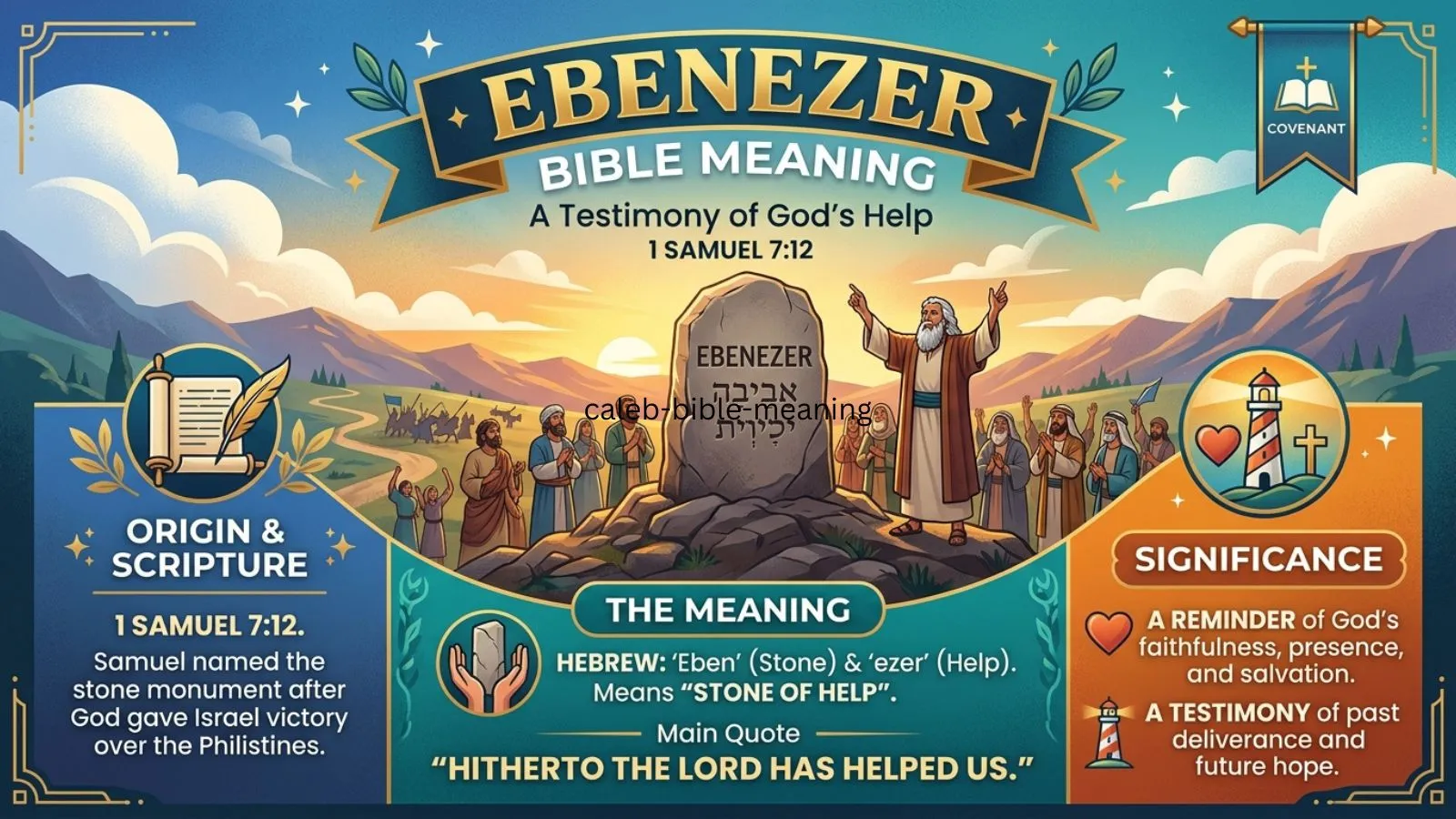
Have you ever wondered how one simple biblical word can remind you of all the ways God has helped you?
I was chatting with a friend when I suddenly saw the term Ebenezer pop up, and honestly, I had no clue what it meant at first.
I kept wondering, “Am I missing something here?” It was a bit confusing, and I didn’t want to respond the wrong way.
So, I decided to look into Ebenezer Bible meaning and understand its true meaning and context.
As I learned more, I discovered that Ebenezer is much more than just a name or an old biblical word.
In the Bible, it points to God’s help and faithfulness.
The word is closely connected with the moment when Samuel set up a stone as a reminder of how the Lord had helped His people.
Understanding this meaning gave the word a deeper and more beautiful purpose.
It can remind believers to look back with gratitude, remember God’s faithfulness, and trust Him through whatever comes next.
If you have come across the word Ebenezer in the Bible, a conversation, or social media, its meaning may carry an encouraging spiritual message worth exploring.
Ebenezer Bible Meaning
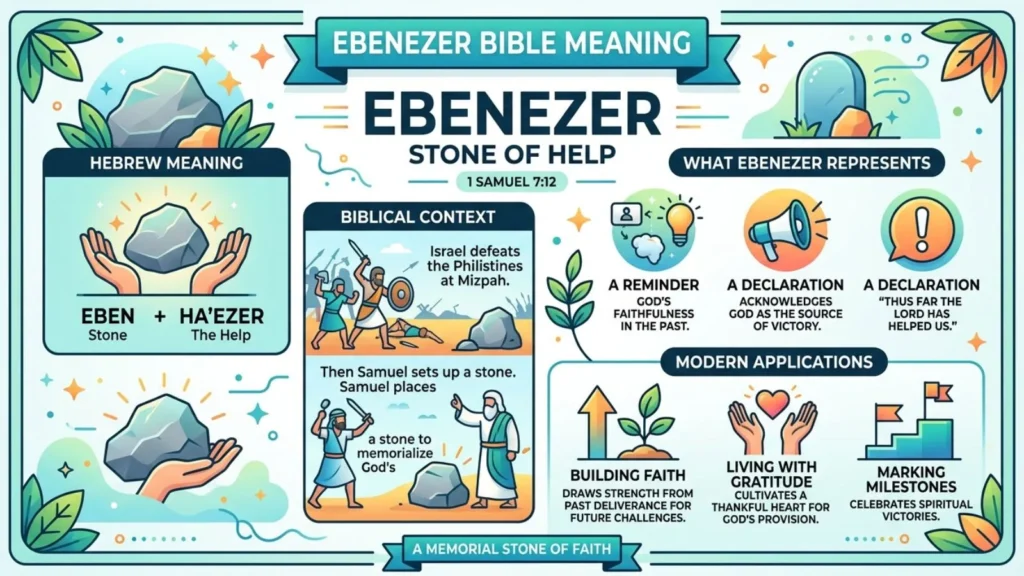
The Ebenezer Bible meaning is “stone of help.” It represents a physical reminder of God’s help and faithfulness.
The main Bible passage about Ebenezer is found in 1 Samuel 7:3–12.
At this time, the Israelites had turned back to God. Samuel encouraged them to remove the false gods among them and serve the Lord faithfully. The people gathered at Mizpah, confessed their sins, and sought God.
The Philistines heard about the gathering and came against Israel.
The Israelites became afraid and asked Samuel to pray for them.
Samuel cried out to the Lord, and God answered. The Lord helped Israel defeat the Philistines.
After this victory, Samuel took a stone and placed it between Mizpah and Shen. He gave the stone the name Ebenezer, saying:
“Thus far the LORD has helped us.”
— 1 Samuel 7:12
This verse gives us the heart of the Ebenezer meaning.
1. Ebenezer Means Remembering God’s Help
Samuel did not want Israel to forget what God had done.
The stone became a reminder of God’s intervention. Whenever the people saw it, they could remember that the Lord had helped them.
This teaches an important lesson for Christians today:
Remembering God’s past faithfulness can strengthen our faith for future challenges.
When life becomes difficult, we can easily focus on what is going wrong. But remembering God’s previous help can bring peace to our hearts.
Think about your own life.
Perhaps there was a time when you felt lost but found direction. Maybe you prayed about something for months and eventually saw an answer. Perhaps God gave you strength during a season when you felt weak.
Those moments can become your personal “Ebenezer” memories.
2. Ebenezer Represents God’s Faithfulness
The stone was not a symbol of human strength. It pointed the people back to God.
Samuel did not say, “Look how strong we were.”
He said, “Thus far the LORD has helped us.”
That distinction matters.
The Christian meaning of Ebenezer is not about trusting ourselves. It is about recognizing God’s faithfulness.
God was their source of help.
Psalm 121:1–2 expresses a similar truth:
“My help comes from the LORD, who made heaven and earth.”
When you feel uncertain about tomorrow, remember what God has already done.
Your past does not guarantee an easy future, but God’s past faithfulness can remind you that you do not walk alone.
3. Ebenezer Can Represent a Turning Point
The story in 1 Samuel 7 also followed a period of spiritual change.
Israel returned to God, and Samuel called the people to worship Him.
Their victory became a turning point.
This gives Ebenezer another spiritual lesson: God can use difficult seasons to bring us back to Him.
Sometimes a painful experience makes us pray more deeply. Sometimes uncertainty teaches us to trust God instead of depending only on ourselves.
An Ebenezer can therefore remind us not only of what God has done but also of how He changed our hearts along the way.
4. Ebenezer Is a Reminder of Hope
The word Ebenezer carries a message of hope because it points backward to God’s help.
When you say, “Thus far the Lord has helped me,” you are recognizing that your story is not only about your struggles.
It is also about God’s presence.
You may still have unanswered prayers. You may still face challenges. But you can look back and see evidence of God’s grace.
That memory can give you courage to continue.
Spiritual Significance and Symbolism of Ebenezer
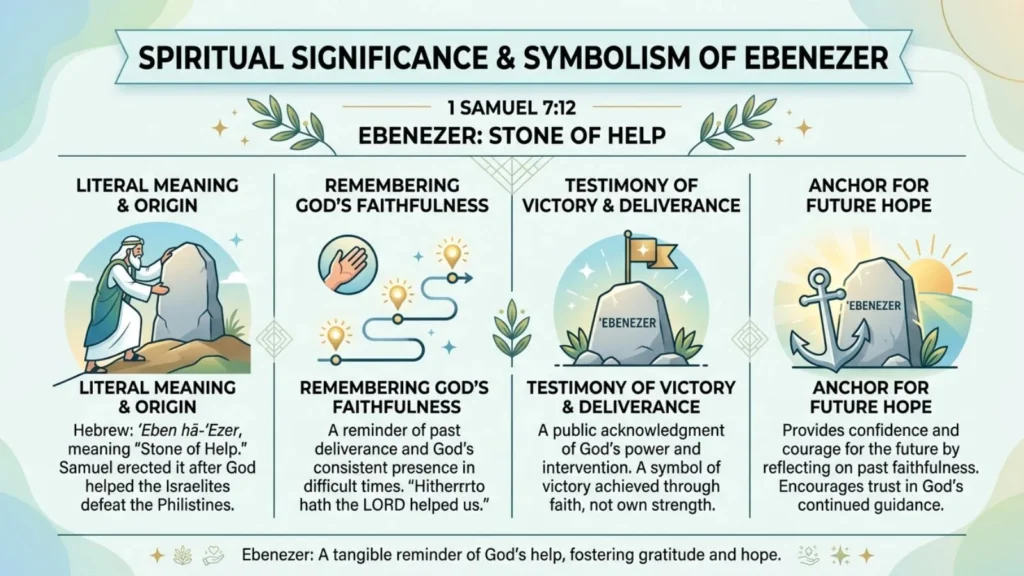
The spiritual symbolism of Ebenezer centers on remembrance, gratitude, faith, and God’s faithfulness.
A Reminder to Give Thanks
An Ebenezer teaches us to stop and remember.
Life moves quickly. We often pray for something, receive help, and then immediately move on to the next problem.
But Scripture shows the value of remembering.
When we remember God’s goodness, gratitude grows.
You might keep a prayer journal and write down prayers you have seen answered. You could record moments when God gave you peace or helped you make a difficult decision.
These memories can become spiritual markers in your journey.
A Sign of Spiritual Growth
Ebenezer can also represent how far God has brought you.
Maybe your faith was once weak, but now you pray with greater trust.
Maybe you once feared every unknown, but you have learned to place tomorrow in God’s hands.
That growth matters.
The words “thus far” are especially meaningful. They recognize that the journey is still continuing.
God helped you this far, and you can continue seeking His guidance for what comes next.
A Call to Trust God Again
Imagine facing a new challenge after experiencing God’s help before.
You can ask yourself:
“What has God already brought me through?”
That question can change your perspective.
Your current problem may be new, but God’s character has not changed.
Hebrews 13:8 reminds believers that Jesus Christ is “the same yesterday and today and forever.”
This does not mean every situation will unfold exactly as we want. Instead, it reminds us that we can continue placing our trust in God.
Ebenezer in Dreams or Real Life

If the word Ebenezer appears in a dream, prayer, Bible reading, or personal reflection, it may naturally bring thoughts of God’s help and remembrance.
However, Christians should be careful about treating every dream as a direct divine message. The Bible remains the foundation for understanding spiritual matters.
If you dream about a stone, memorial, or place of remembrance, you might reflect on what God has brought you through.
A peaceful stone or memorial could remind you of gratitude, stability, and God’s faithfulness.
A broken or forgotten memorial might encourage personal reflection. You could ask whether you have forgotten God’s past blessings or become focused only on present problems.
The safest response is always prayer and biblical reflection, rather than fear.
Ask God for wisdom and compare your thoughts with Scripture.
James 1:5 encourages believers to ask God for wisdom, trusting that He gives generously.
Practical Lessons and Faith of Ebenezer

The Ebenezer Bible meaning teaches us to remember God’s help instead of forgetting His faithfulness.
Take time to write down answered prayers, difficult seasons God helped you through, and moments when you experienced His peace.
When a new challenge comes, look back and remember: “Thus far the Lord has helped me.”
Let gratitude strengthen your faith, and let prayer guide your next step.
Conclusion
The Ebenezer Bible meaning is a beautiful reminder of God’s help, faithfulness, protection, and grace.
In 1 Samuel 7:12, Samuel raised a stone to remember how the Lord had helped Israel.
Today, we can also remember the ways God has carried us through life’s difficult seasons.
Your journey may not be finished, but you can look back with gratitude and move forward with hope.
Thus far, the Lord has helped you—and you can trust Him with what comes next.
Continue Reding:
- Caleb in the Bible Meaning: Courage, Faith, Perseverance, and God’s Reward
- Staff in the Bible: Meaning, Symbolism, and Spiritual Significance
- Biblical Meaning of Pride: Lessons on Humility, Sin, and God’s Grace