What if the talents God has placed in your life are meant for a greater purpose than you realize?
I want to share something that happened to me recently about Talents in the Bible Meaning. I was chatting with a friend when I suddenly saw this term pop up.
Honestly, I had no clue what it meant at first. I kept wondering, “Am I missing something here?” It felt a little confusing, and I did not want to respond the wrong way.
So, I decided to look into the Biblical meaning of talents and understand their true meaning and context.
As I learned more, I discovered that talents in the Bible are not only about natural abilities, skills, or gifts.
They can also represent responsibility, trust, opportunity, and the blessings God places in our care.
After understanding the meaning, I realized how important it is to know Biblical terms, especially when they appear in conversations, social media posts, or faith-based discussions.
Learning the proper meaning helped me respond with more confidence and avoid feeling confused or unsure.
Now, whenever I see the word “talents” in a Biblical context, I understand that it carries a deeper spiritual message.
It reminds believers to use what God has given them wisely, faithfully, and for a meaningful purpose.
Biblical Meaning of Talents in the Bible
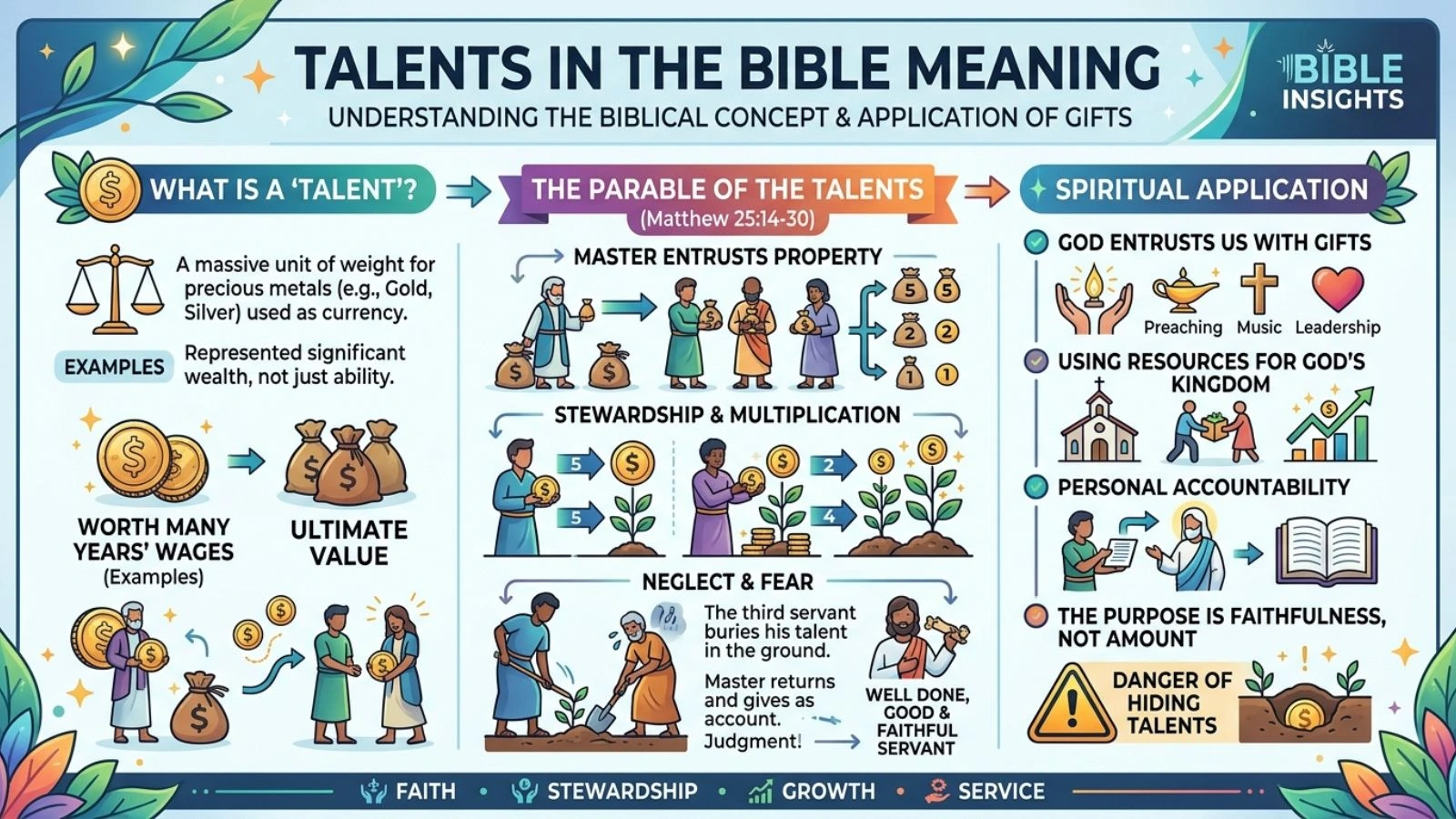
The main Bible passage about talents is found in Matthew 25:14–30. This story is known as the Parable of the Talents.
In the parable, a master prepares to travel. Before leaving, he gives money to three servants. One servant receives five talents. Another receives two talents. The third receives one talent.
The master gives each servant an amount according to their ability.
The first servant uses his five talents and gains five more. The second servant also works with what he receives and gains two more.
However, the third servant becomes afraid. He hides his talent in the ground and returns only the original amount.
When the master returns, he praises the first two servants. He says:
“Well done, good and faithful servant.” — Matthew 25:21
This verse shows an important part of the biblical meaning of talents. God values faithfulness.
The servants were not praised because they received the same amount. They were praised because they used what they had responsibly.
Talents Represent Gifts and Opportunities
In the original story, a talent was a valuable amount of money. Yet the parable also gives a wider spiritual lesson.
Today, many Christians understand talents as symbols of:
- Natural abilities
- Spiritual gifts
- Time and opportunities
- Knowledge and wisdom
- Kindness and compassion
- Leadership and service
- Faith and personal influence
God may give one person the gift of teaching. Another may be good at listening and helping people. Someone else may bring peace to a difficult situation.
These gifts may look different, but they can all have value.
The Bible teaches that people receive different gifts. Romans 12:6 says:
“We have different gifts, according to the grace given to each of us.”
This means that not everyone is called to do the same thing. Your purpose does not need to look like another person’s purpose.
God does not ask you to become someone else. He invites you to use what He has given you.
The Meaning of Faithful Use
The first two servants did not hide their talents. They acted with trust. They used what they received and allowed it to grow.
Spiritually, this can mean using your gifts to bring good into the world.
For example, a person with a kind heart may support someone who feels alone. A person who understands Scripture may help others learn. A creative person may use art or writing to share hope.
Even small actions can have a meaningful effect.
The Bible also says in 1 Peter 4:10:
“Each of you should use whatever gift you have received to serve others.”
This verse connects gifts with service. A talent is not only something to enjoy. It can also become a way to help others and reflect God’s love.
The Warning Meaning of Hidden Talents
The third servant was afraid. Instead of using his talent, he buried it.
His choice may represent fear, doubt, avoidance, or missed opportunities.
Sometimes people hide their gifts because they think they are not good enough. They may fear criticism or failure. They may wait for the perfect time before taking action.
However, fear can stop spiritual growth.
The parable does not teach that everyone must become successful or famous. It teaches that people should not waste the gifts and opportunities they have received.
The warning is gentle but clear: do not allow fear to bury what God may want you to use.
This does not mean rushing or putting pressure on yourself. Growth can happen slowly. A small step of faith may be enough to begin.
Talents and God’s Trust
The master trusted the servants with something valuable. In a similar way, the parable reminds believers that life contains responsibilities.
Your time matters ,words and choices matter.
God may place opportunities in your path that allow you to learn, grow, serve, or encourage someone.
The spiritual message is not, “You must do everything.” Instead, it is, “Be faithful with what you have.”
This brings peace because you do not have to carry another person’s purpose. You can focus on the gifts and responsibilities God has placed in your own life.
Spiritual Significance and Symbolism
The spiritual symbolism of talents is closely connected with faith, growth, purpose, and responsibility.
Talents remind believers that every person has something valuable to offer. Some gifts are easy to see, while others are quiet.
A person may not sing, teach, or lead a large group. Yet they may have patience, wisdom, kindness, or the ability to make others feel safe. These gifts can also reflect God’s love.
The Parable of the Talents teaches that spiritual growth often begins with what is already in your hands.
You may feel that your ability is small. But small gifts can grow when they are used with faith.
For example, you may begin by helping one person. You may pray for someone who is struggling. You may share a kind word when another person feels discouraged.
Over time, these actions can create positive change.
Talents Can Lead to Spiritual Growth
Using your gifts may help you grow closer to God.
You may become more confident in prayer, learn to trust God’s guidance and discover new ways to serve others.
This can lead to a quiet spiritual awakening.
Growth does not always happen through a big moment. Sometimes it happens through daily faithfulness.
You may feel nervous when you begin. You may make mistakes. Yet God can teach and guide you through the process.
Philippians 1:6 gives hope by saying that God will continue the good work He has begun.
This reminds believers that they do not need to be perfect before using their gifts.
Talents Teach Us Not to Compare
One servant received five talents, another received two, and another received one.
The master did not ask why each servant received a different amount. Each person was responsible for what they had.
This teaches an important lesson about comparison.
You may see someone with many visible skills and wonder why your gifts seem smaller. But God’s purpose is not measured by attention, popularity, or praise.
Your gift may be quiet, but it can still be meaningful.
Faithfulness matters more than comparison.
The spiritual message of talents encourages people to be thankful, grow with patience, and trust God’s plan.
Biblical Interpretations in Dreams or Real Life
Some people search for the dream interpretation of talents after dreaming about money, gifts, skills, or receiving something valuable.
The Bible does not give one fixed meaning for every dream. Therefore, dreams should be considered carefully and prayerfully.
A dream about receiving a talent may represent a new opportunity, responsibility, or ability. It may encourage you to notice a gift you have ignored.
A dream about using a talent may reflect growth, confidence, or a desire to serve others.
If you dream about losing or hiding a talent, it may point to fear, doubt, or a feeling that you are not using your abilities. However, it should not automatically be seen as a warning from God.
Prayer and wise reflection are important.
In real life, you may discover your gifts through experiences. You may notice what you enjoy, what you do well, or how you naturally help others.
A peaceful feeling may encourage you to continue growing. A difficult season may teach patience and strength.
Whatever you experience, seek God’s guidance instead of depending only on signs or feelings.
Practical Lessons and Faith Insights
The meaning of talents encourages you to:
- Thank God for the gifts you have.
- Stop comparing your journey with others.
- Use your abilities to help people.
- Take small steps when you feel afraid.
- Pray for wisdom and direction.
- Grow patiently and trust God’s timing.
Ask yourself: “What has God placed in my hands, and how can I use it with love?”
Conclusion
The talents in the Bible meaning teaches that God gives people valuable gifts, opportunities, and responsibilities.
The Parable of the Talents reminds us to use these blessings with faith rather than hiding them in fear.
You do not need to have the same gifts as others. What matters is being faithful with what God has given you.
Through prayer, service, and steady growth, even a small gift can become a source of hope and blessing.
Trust God’s guidance, use your gifts with love, and allow your faith to grow one step at a time.