The Bible was not written in a single day—or even during one lifetime. Its story was recorded across many centuries by different authors, yet it carries one powerful message of faith, hope, and God’s love.
I was chatting with a friend when the question “When Was the Bible Written?” suddenly came up.
At first, I had no clear answer. I wondered, “Was the Bible written all at once, or did it take many years?”
The question felt confusing because the Bible contains many books, stories, prophecies, letters, and teachings written by different people.
Curious to understand more, I began exploring when the Bible was written and how its books came together.
I learned that the Bible was written over a long period, beginning with the books of the Old Testament and continuing through the writings of the New Testament.
Different authors recorded these sacred messages in different places and historical times.
As I learned more, I realized that understanding the Bible’s timeline helps us appreciate its depth and lasting importance.
It also makes conversations about Scripture easier and more meaningful. Knowing when the Bible was written gave me more confidence to discuss its history and understand how God’s message has been shared across generations.
When Was the Bible Written?
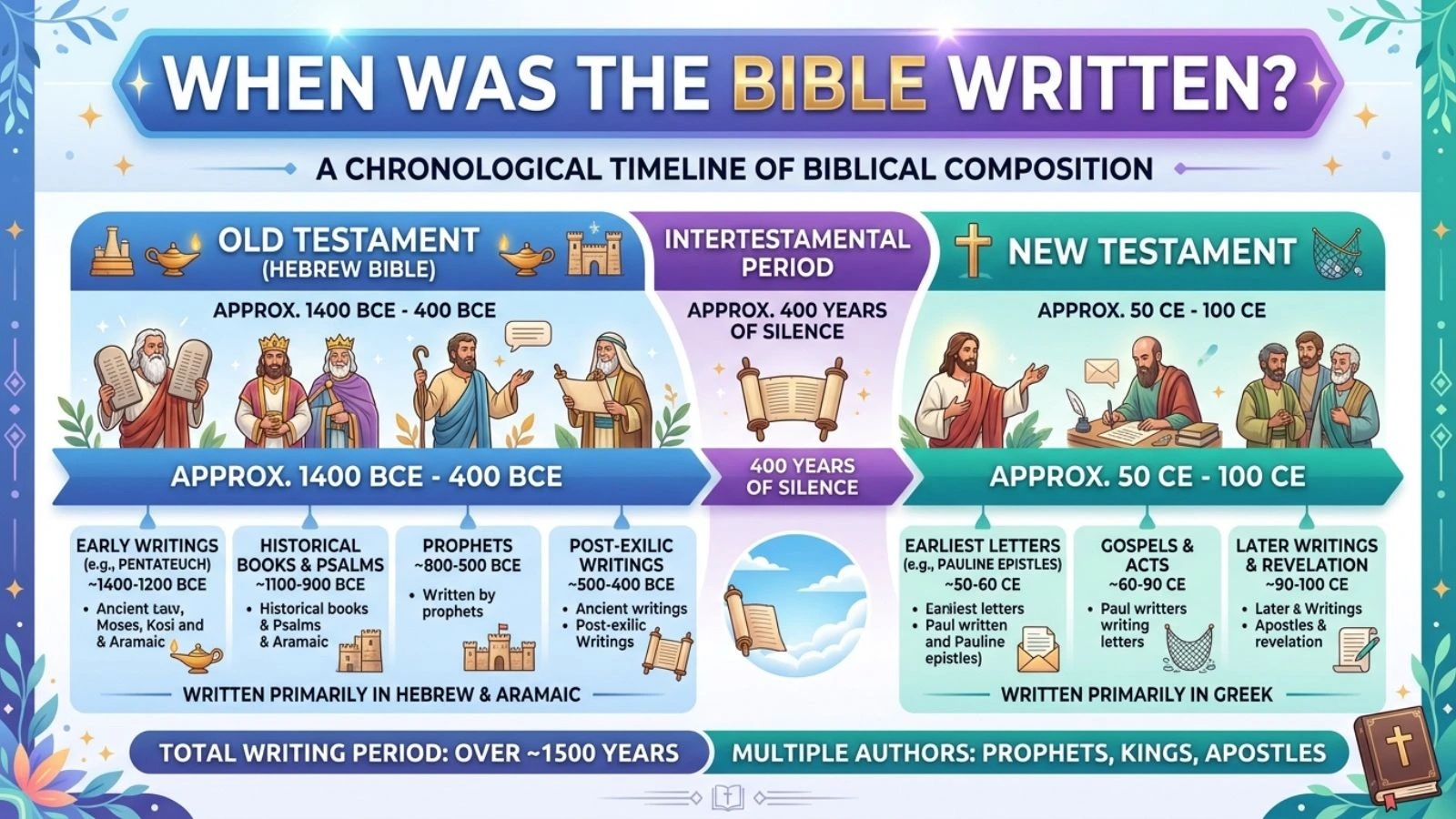
The Bible was written over a very long period. Many scholars believe its books were written across roughly 1,000 to 1,500 years.
The exact dates are not known for every book. Some books may have been written earlier or later than scholars first believed. However, the Bible’s general timeline is usually divided into two main parts:
- The Old Testament
- The New Testament
The Old Testament was written before the birth of Jesus Christ. The New Testament was written during the first century after Jesus lived on earth.
When Was the Old Testament Written?
The Old Testament contains 39 books. It tells the story of God’s relationship with His people before the coming of Jesus.
Many Old Testament writings were produced between about 1400 BC and 400 BC, although scholars debate the dates of several books.
The first five books are called the Pentateuch or the Books of Moses:
- Genesis
- Exodus
- Leviticus
- Numbers
- Deuteronomy
These books tell about creation, God’s covenant, the lives of Abraham, Isaac, and Jacob, and the journey of the Israelites.
Other Old Testament books tell about kings, prophets, worship, wisdom, and God’s promises. The Psalms gave people words for prayer. Proverbs taught wisdom for daily life. The prophets called people back to faith and pointed toward future hope.
The Old Testament ends with books written several centuries before Jesus was born.
When Was the New Testament Written?
The New Testament contains 27 books. Most scholars believe these books were written between about AD 45 and AD 100.
The New Testament begins with the four Gospels:
- Matthew
- Mark
- Luke
- John
These books tell about the life, teachings, death, and resurrection of Jesus Christ.
The Book of Acts explains how the early Christian church began. The letters, also called epistles, gave guidance and encouragement to Christian communities. The final book, Revelation, gave hope to believers facing hardship.
The New Testament was written in a time when many Christians experienced pressure and suffering. Its message reminded believers that Jesus was present with them and that God’s promises remained true.
What Does the Bible Say About Its Message?
The Bible teaches that Scripture has a special purpose in the life of faith.
2 Timothy 3:16–17 says that Scripture is inspired by God and is useful for teaching, correction, and training in righteousness.
This does not mean every Bible book was written in the same way. God worked through different people, languages, experiences, and writing styles. Some writers recorded history. Some wrote songs. Some shared wisdom. Others gave spiritual guidance through letters.
Yet the Bible carries one connected message: God reaches toward humanity with truth, mercy, and love.
Why Did It Take So Long to Write the Bible?
The Bible tells a long story because God’s work unfolded across many generations.
The story begins with creation. It continues through God’s promises to Abraham, the life of Israel, the words of the prophets, and the coming of Jesus Christ. The New Testament then shares how the message of Jesus spread through the early church.
Each book adds something important.
Some books show human weakness. Some reveal God’s faithfulness. Some speak about justice. Others bring comfort during sorrow.
The long timeline also reminds us that faith is often a journey. God’s people did not understand everything at once. They learned, failed, prayed, waited, and grew.
This can bring comfort today. Sometimes we also wait for answers. We may not understand what God is doing in a difficult season. The Bible shows that God’s work can continue even when the full picture is not yet clear.
A Helpful Timeline of the Bible
Here is a simple overview:
- Around 1400–400 BC: Many Old Testament books were written.
- Around 4–6 BC: Jesus was likely born.
- Around AD 30–33: Jesus was crucified and rose again.
- Around AD 45–100: The New Testament books were written.
- Over later centuries: Christian communities recognized and gathered the books that form the Bible.
These dates are estimates. Different scholars may give slightly different dates, especially for some Old Testament books.
The important point is that the Bible was written over many centuries and preserved through generations.
Spiritual Significance of the Bible’s Long History
The question “When was the Bible written?” is also a question about God’s faithfulness.
The Bible was written across many generations, yet its message continues to speak about faith, hope, love, forgiveness, and God’s guidance.
People changed. Nations rose and fell. Languages developed. Cultures changed. Still, the Bible remained a source of comfort and spiritual strength.
This can remind us that God’s truth is not limited to one moment in history.
A person may read a Psalm during a hard day and feel comfort. Someone may read the words of Jesus and find hope. Another person may read a letter from Paul and feel encouraged to remain strong in faith.
The Bible’s long journey can also show us that spiritual growth takes time.
God often works patiently. A person may grow through prayer, learning, mistakes, and life experiences. Change may happen slowly, but faith can become stronger over time.
The Bible also connects believers to people who lived long ago. David wrote prayers during times of joy and pain. The prophets spoke during difficult periods. The disciples followed Jesus and shared His message.
Their experiences may be ancient, but many feelings are familiar today.
People still search for peace. They still ask for guidance. They still hope for a better future.
Through Scripture, believers can remember that God has been guiding people throughout history.
Biblical Interpretations in Dreams or Real Life
However, dreaming about reading an old Bible, finding Scripture, or seeing ancient Bible pages may encourage personal reflection.
A peaceful dream about reading the Bible may remind a person to seek wisdom, prayer, or spiritual guidance. A dream where the Bible feels lost may reflect a desire to reconnect with faith.
Christian belief encourages people to test spiritual thoughts through Scripture, prayer, wisdom, and truth.
It can help readers see that Scripture came through real people living in real places during important moments in history.
The Bible’s age does not make its message distant. For many believers, its words still bring comfort and direction today.
Practical Lessons and Faith Insights
Read it slowly and ask what each passage teaches about God, faith, hope, and daily life.
Pray for wisdom when a verse feels difficult. Remember that spiritual growth often takes time. Just as the Bible’s story unfolded across generations, God may also guide your life one step at a time.
Conclusion
The Bible’s long history reflects a continuing story of God’s faithfulness, guidance, and hope. Its words have encouraged people for generations and still speak to hearts today.
As you read Scripture, ask God for wisdom and trust that His guidance can bring light to every season of life.