Have you ever wondered what Rebecca’s name means in the Bible and why her story still matters to believers today?
Rebecca is one of the most memorable women in the Bible, known for her kindness, courage, and important role in God’s plan.
Her story begins in Genesis when Abraham’s servant meets her at a well and recognizes her generous heart.
At first, I wondered why Rebecca was given such an important place in Scripture and what her name could teach us about faith.
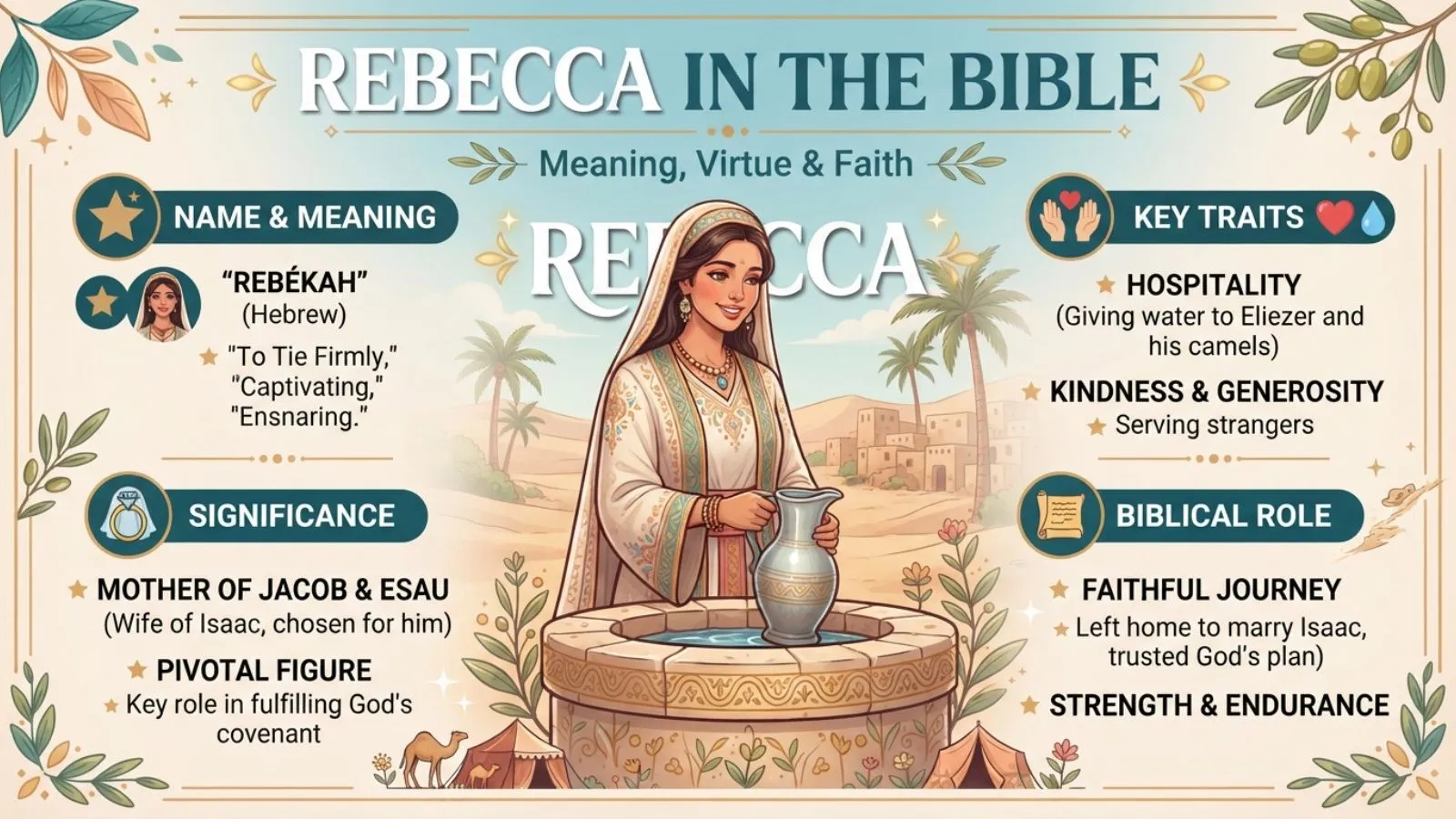
As I looked deeper into Rebecca in the Bible meaning, I discovered that her name is commonly understood as “to tie,” “to bind,” or “captivating.”
Her biblical story carries deeper lessons about kindness, obedience, family, faith, and trusting God’s direction.
Rebecca became the wife of Isaac and the mother of Esau and Jacob, making her an important part of the story of God’s covenant people.
Her life was not perfect, but her journey shows how God can work through ordinary choices and unexpected moments.
From offering water to a stranger to becoming part of Isaac’s family, Rebecca’s story reminds us that small acts of kindness can have a much greater purpose.
In this article, we will explore Rebecca in the Bible meaning, her name’s significance, her story in Genesis, her spiritual symbolism, and the lessons Christians can learn from her life.
Rebecca in the Bible Meaning
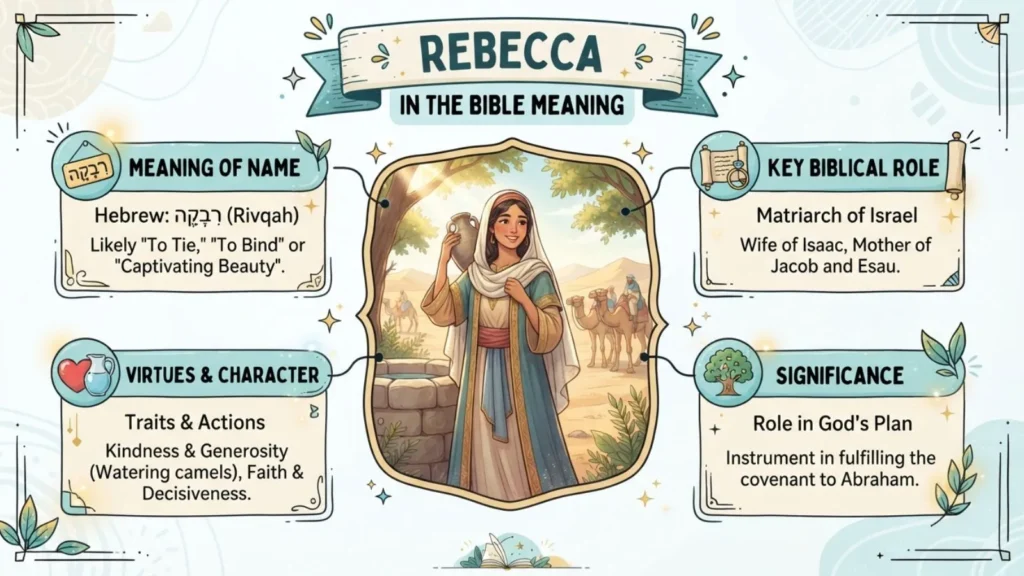
The name Rebecca comes from the Hebrew name Rivkah (רִבְקָה). Its exact meaning is not completely certain, but it is often connected with ideas such as “to tie,” “to bind,” or “captivating.”
In the Bible, Rebecca’s story gives her name a deeper spiritual context. Her life became closely connected to God’s covenant promise and the future of Israel.
1. Rebecca Represents Kindness
One of the clearest lessons from Rebecca is kindness.
In Genesis 24:18–20, Abraham’s servant asks Rebecca for a little water. She willingly gives him water and then goes further by drawing enough water for his camels.
This was not a small task. It required effort and patience.
Rebecca did not know that her simple kindness was connected to a major answer to prayer.
This teaches an important Christian lesson: God can use ordinary acts of kindness for extraordinary purposes.
Sometimes we may think our small actions do not matter. A kind word, helping someone, listening to a friend, or showing patience may seem simple. Yet God sees the heart behind those actions.
2. Rebecca Represents God’s Guidance
Rebecca’s story is strongly connected to divine guidance.
Abraham’s servant prayed for God to show him the right woman for Isaac. His prayer is recorded in Genesis 24:12–14.
When Rebecca appeared and responded with kindness, the servant recognized God’s answer.
This does not mean every event in life has an obvious sign attached to it. Instead, Rebecca’s story reminds us to seek God through prayer and wisdom when making important decisions.
God’s guidance may come through Scripture, wise counsel, prayer, circumstances, and a growing sense of peace.
3. Rebecca Represents Willingness
Rebecca also showed a willing heart.
After learning about Isaac and Abraham’s family, she was asked whether she would go with the servant. Her response was simple:
“I will go.” — Genesis 24:58
Rebecca was willing to leave her familiar surroundings and begin a new life.
Her decision shows faith and courage. She did not know everything that would happen in the future, but she was willing to take the next step.
For Christians, this can be a powerful reminder. Faith does not always mean knowing every detail. Sometimes faith means trusting God with the next step.
4. Rebecca Represents Family and Covenant
Rebecca became Isaac’s wife and later gave birth to Esau and Jacob.
Genesis 25:21 tells us that Isaac prayed to the Lord because Rebecca was unable to have children, and the Lord answered his prayer. Rebecca eventually became pregnant with twins.
Her children would play a major role in the biblical story.
Through Rebecca, we see how one person’s life can become part of a much larger divine plan.
Her story connects to God’s promise to Abraham and Isaac. This makes Rebecca an important figure in the story of God’s covenant people.
5. Rebecca Also Teaches About Human Weakness
Rebecca’s story is not perfect.
Later in Genesis, Rebecca became involved in helping Jacob receive Isaac’s blessing. Genesis 27 shows that she planned and encouraged Jacob to receive the blessing meant for Esau.
This part of her story gives us a warning.
Even people who have shown great faith can make decisions based on fear, preference, or human reasoning. Rebecca knew that Jacob had a special future, but she chose to act through her own plan.
Her story therefore teaches both faith and caution.
We can trust God’s promises without trying to control every outcome ourselves.
Spiritual Significance and Symbolism of Rebecca
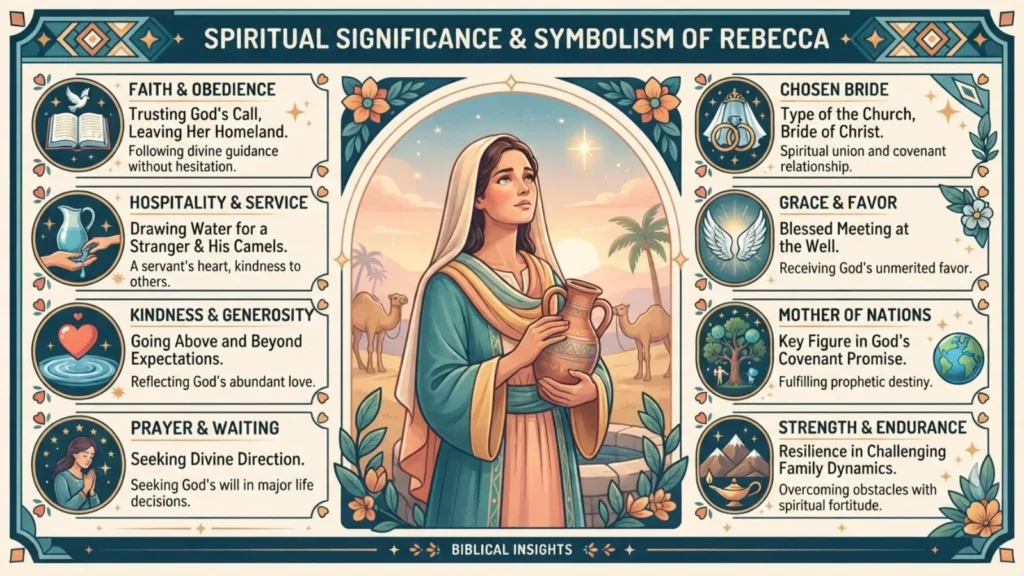
The spiritual symbolism of Rebecca centers on kindness, faith, willingness, and God’s purpose.
Her meeting with Abraham’s servant is especially meaningful. She was simply going about her daily life when an unexpected opportunity to show kindness appeared.
She did not know what her actions would lead to.
This can speak to our own lives.
You may be doing ordinary things each day while wondering whether your life has a greater purpose. Rebecca’s story reminds us that God can work through ordinary moments.
Kindness Can Open Unexpected Doors
Rebecca’s kindness at the well became connected to a major turning point in her life.
This does not mean every kind action will immediately bring a reward. Instead, it shows that God values a heart that serves others.
Kindness is never wasted in God’s sight.
Faith Requires Courage
Rebecca had to leave her home and enter a new chapter.
Her words, “I will go” (Genesis 24:58), reflect a willingness to move forward.
There may be moments when God calls us to leave behind fear, old habits, or uncertainty. Rebecca’s story encourages us to move forward with faith rather than fear.
God Works Through Seasons of Waiting
Rebecca also experienced a season of waiting for children. Isaac prayed, and God answered.
This reminds us that waiting does not mean God has forgotten us.
Sometimes prayer is followed by an immediate answer. At other times, God asks us to wait and trust His timing.
Rebecca’s life shows that God’s purpose can unfold slowly.
Rebecca in Dreams or Real Life: Biblical Interpretation

If you see the name Rebecca in a dream or repeatedly encounter it in real life, it is wise not to assume that it automatically represents a direct message from God.
The Bible encourages believers to seek God through prayer and Scripture, rather than relying only on signs or dreams.
Still, Rebecca’s biblical story can provide helpful themes for reflection.
Seeing Rebecca may remind someone of kindness, courage, family, faith, or divine guidance. If the experience feels peaceful, it may encourage reflection on trusting God and serving others.
If the experience creates fear or confusion, it may be better to pause and pray rather than immediately assigning a spiritual meaning to it.
Ask God for wisdom and compare any spiritual impression with biblical truth.
Practical Lessons of Rabecca and Faith Insights
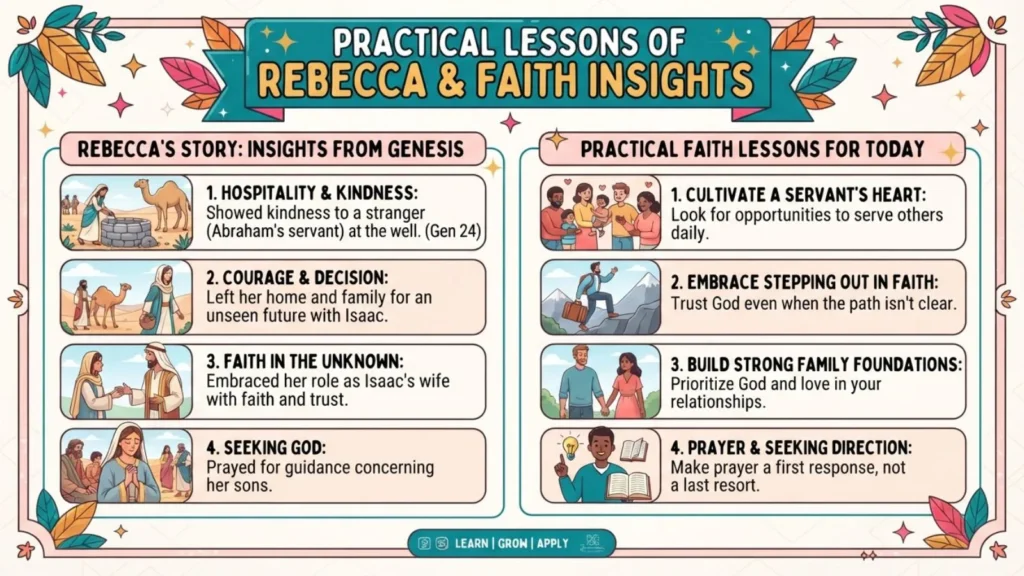
Rebecca teaches us to serve with kindness, trust God’s guidance, and move forward with courage.
Her story also reminds us not to force God’s promises through our own plans. Pray before making important choices, remain patient during seasons of waiting, and let Scripture guide your decisions.
God can use even the smallest act of faithfulness for a greater purpose.
Conclusion
The Rebecca in the Bible meaning points to kindness, faith, courage, family, and participation in God’s greater plan.
Her life shows that ordinary moments can have lasting meaning when placed in God’s hands.
At the same time, her mistakes remind us to trust God instead of trying to control His promises.
Whatever season you are in, keep praying, keep trusting, and seek God’s guidance with a willing heart.
Continue Reding:
- Lucas Bible Meaning: Biblical Significance, Origin, and Spiritual Meaning
- The Biblical Meaning of Blue: Faith, Heaven, and God’s Presence
- Manna in the Bible Meaning: Lessons About Faith, Trust, and Daily Provision