Have you ever wondered what it truly means to trust God when you cannot see what He is doing?
Hey, I want to share something that happened to me recently about Trust in the Bible Meaning.
I was chatting with a friend when I suddenly saw this term pop up, and honestly, I had no clue what it meant at first. I kept wondering, “Am I missing something here?”
It was a bit confusing, and I didn’t want to respond the wrong way.
So, I decided to look into trust in the Bible meaning and understand its biblical context.
After learning more about it, I realized that trust is much deeper than simply believing someone.
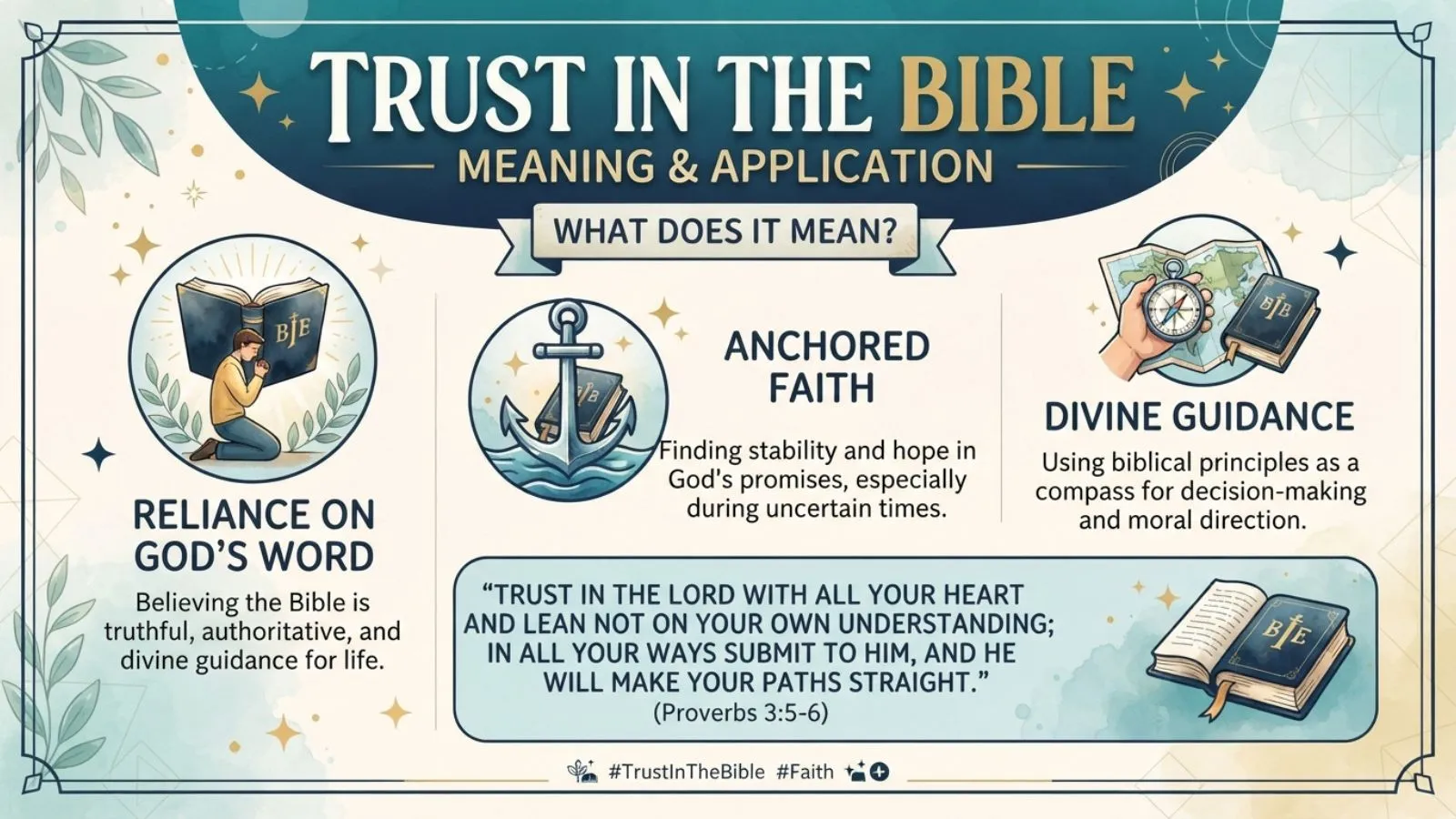
In the Bible, trusting God means depending on Him, believing His promises, and having faith even when the path ahead is unclear.
Understanding this meaning helped me see why trust is such an important part of Christian faith.
It reminds us that even when life feels uncertain, God remains faithful.
Proverbs 3:5 encourages believers to “Trust in the Lord with all your heart” and not depend only on their own understanding.
After understanding it, I felt more confident whenever I came across the word trust in conversations, Bible studies, or social media.
More importantly, I learned that biblical trust invites us to place our worries, plans, and future into God’s hands.
Biblical Meaning of Trust
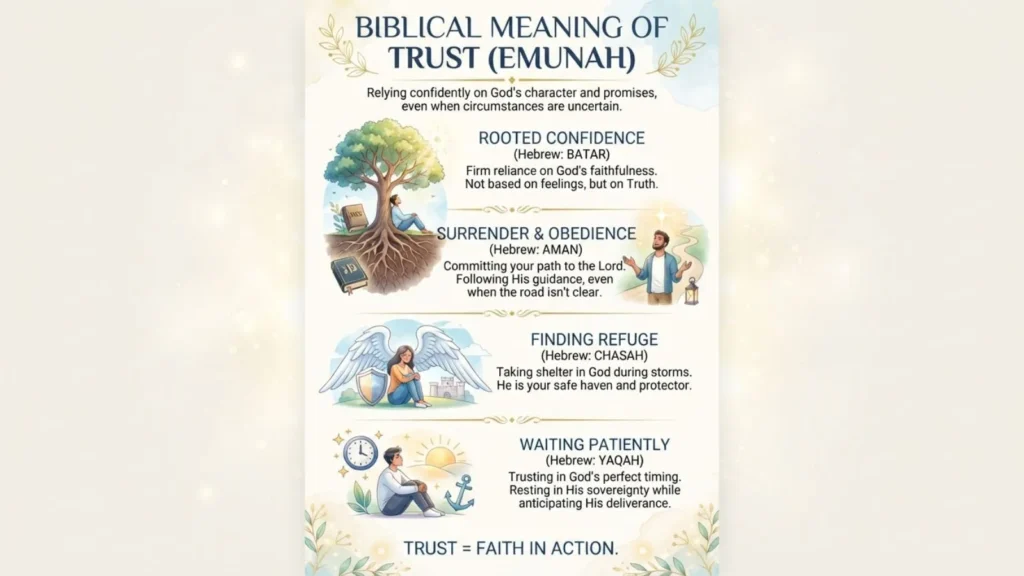
The biblical meaning of trust is to place your confidence, hope, and dependence in God. Scripture teaches that God is worthy of our trust because His character does not change.
Psalm 9:10 says:
“And they that know thy name will put their trust in thee: for thou, Lord, hast not forsaken them that seek thee.”
This verse connects trust with knowing God. The more we understand His character, the more we can depend on Him.
Trust Means Depending on God
Trusting God means recognizing that our own understanding is limited. We see only one part of the story, while God sees the whole picture.
Proverbs 3:5–6 teaches believers not to depend completely on their own understanding. Instead, they should acknowledge God in all their ways.
Imagine walking through a dark room while holding someone’s hand. You may not see where you are going, but you trust the person guiding you.
Faith can feel like that.
You may not know what tomorrow holds, but God already knows the way ahead.
Trust Is Connected to Faith
Trust and faith are closely connected in Christian belief. Hebrews 11:1 describes faith as confidence in what we hope for and assurance about what we do not see.
This does not mean believing without reason. It means choosing to believe God’s promises even when circumstances create fear.
For example, you may be waiting for a job, facing a difficult decision, or praying for someone you love. You may not know how the situation will end. Trust allows you to say, “God, I do not understand everything, but I believe You are with me.”
Trust Brings Peace
Trust also helps calm the heart.
Isaiah 26:3 says:
“Thou wilt keep him in perfect peace, whose mind is stayed on thee: because he trusteth in thee.”
Notice the connection between trust and peace. When our minds remain focused on God, fear does not have to control us.
This does not mean Christians never worry. It means worry does not have to have the final word.
When anxiety rises, prayer can become an act of trust. Instead of carrying every question alone, you can bring it before God.
Trusting God During Difficult Times
The Bible does not promise that faithful people will never experience trouble. Many biblical figures faced fear, loss, waiting, and uncertainty.
David often wrote about trusting God while facing danger. Psalm 56:3 says:
“What time I am afraid, I will trust in thee.”
This is a beautiful lesson. David does not say, “I will never be afraid.”
He says, “When I am afraid, I will trust.”
That difference matters.
Trust is not the absence of fear. It is choosing God even when fear is present.
A Warning About Misplaced Trust
The Bible also warns against placing ultimate trust in people, wealth, power, or our own strength.
Psalm 118:8 says:
“It is better to trust in the Lord than to put confidence in man.”
People can disappoint us. Money can disappear. Plans can change. Our own strength can fail.
But God’s faithfulness remains.
This does not mean we should never trust other people. Healthy relationships require trust. The biblical warning is about making anything other than God the foundation of our hope.
When God is our foundation, other blessings can be received without becoming our source of security.
Spiritual Significance and Symbolism of Trust
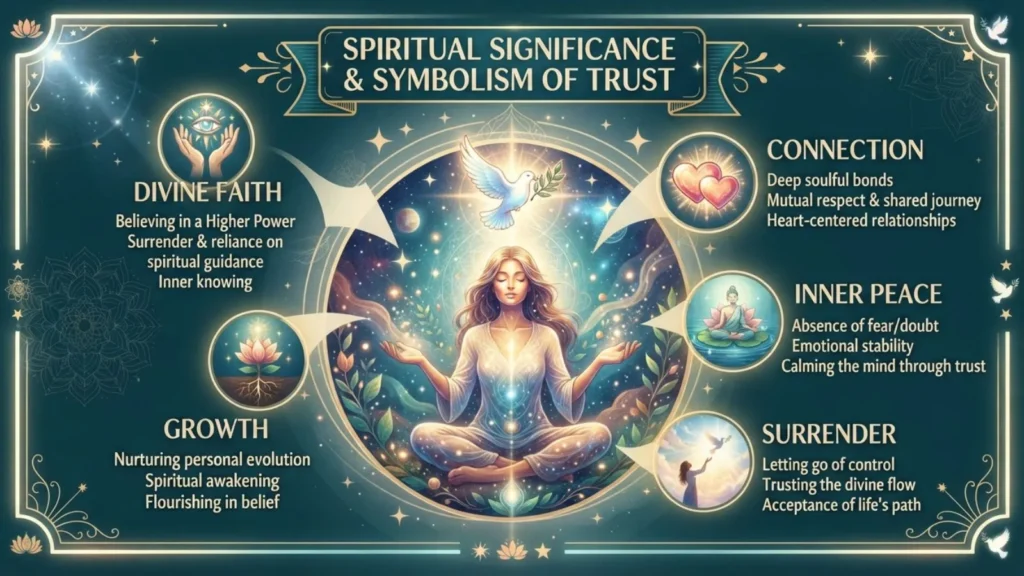
The spiritual symbolism of trust points to surrender, faith, patience, and dependence on God.
Trust is often most powerful when you cannot see the answer yet.
Trust Teaches Surrender
Sometimes we pray for a specific outcome because we believe it is best. But trusting God means being willing to surrender our plans to His wisdom.
Jesus showed this kind of surrender in the Garden of Gethsemane. In Matthew 26:39, He prayed to the Father and submitted to His will.
This teaches an important spiritual lesson: trust allows us to release control without giving up hope.
Trust Builds Spiritual Growth
Every season of uncertainty can become an opportunity for spiritual growth.
When you trust God through a difficult season, your faith can become stronger. You learn that God’s presence is not limited to good days.
A person who once prayed only when everything was easy may begin to pray more deeply during hardship. A season of waiting can become a season of spiritual awakening.
Trust grows through practice.
You may start with a small prayer:
“God, help me trust You today.”
That simple prayer can become a powerful step of faith.
Trust Gives Hope for Tomorrow
Biblical trust also gives believers hope.
Jeremiah 17:7 says:
“Blessed is the man that trusteth in the Lord, and whose hope the Lord is.”
Here, trust and hope are closely joined.
When your hope rests on God, changing circumstances do not have to destroy your peace. You can continue moving forward while waiting for His guidance.
Biblical Interpretations of Trust in Dreams or Real Life
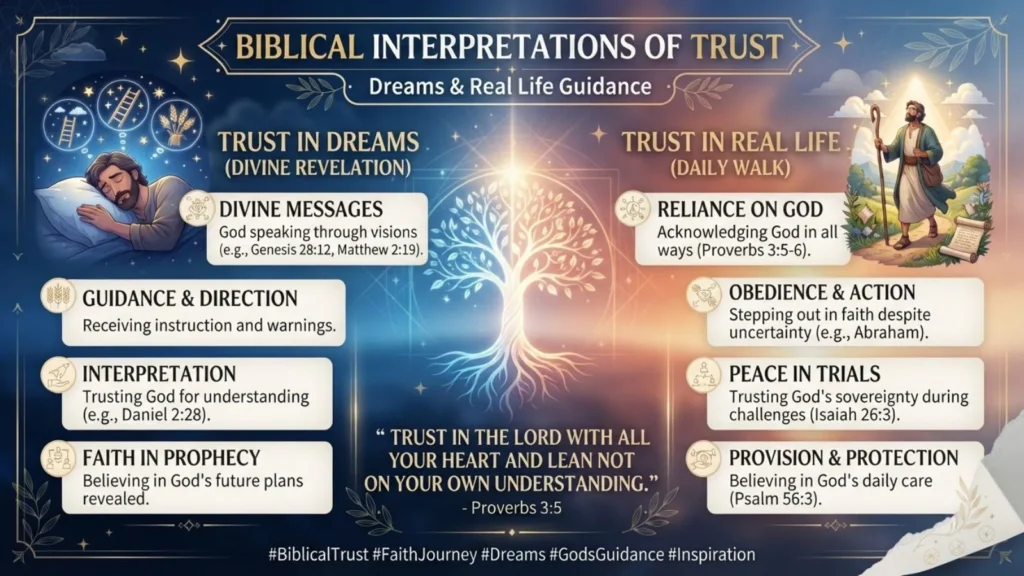
Trust may appear as a spiritual theme in dreams, prayer, personal reflection, or everyday experiences.
If you dream about walking safely despite darkness, it may remind you of the biblical idea of following God even when the future is unclear.
If you dream about falling but being caught, the image may reflect a desire for safety, support, or surrender. However, dreams should not automatically be treated as divine messages. The Bible should remain the foundation for Christian discernment.
If you experience a peaceful moment after a season of fear, you may see it as an opportunity to remember God’s faithfulness.
Likewise, a difficult or frightening situation can remind you of Psalm 56:3: “When I am afraid, I will trust in thee.”
Rather than trying to find a hidden message in every event, bring your experiences to God in prayer and wisdom.
Ask:
- Does this lead me closer to God?
- Does it agree with Scripture?
- Is it producing faith, wisdom, and peace?
These questions can help keep spiritual interpretation grounded in Christian belief.
Practical Lessons and Faith of Trust
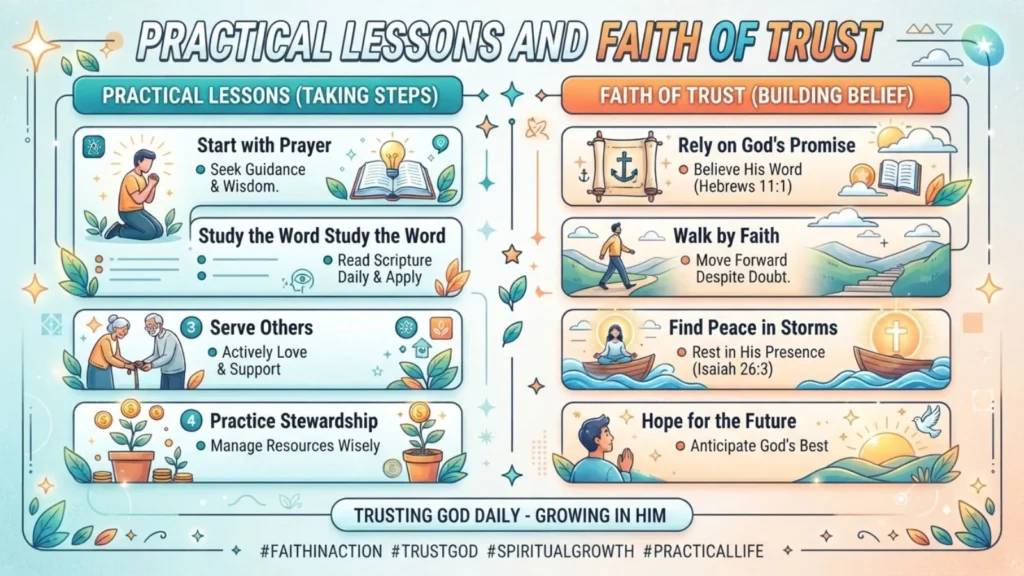
Trusting God is something we practice every day.
When you feel uncertain, pray before you panic. When you cannot control the outcome, surrender it to God. When answers take time, remember His faithfulness.
Read Bible verses about trust, spend quiet time in prayer, and take one faithful step at a time.
You do not need to understand the whole journey to trust the One who leads you.
Conclusion
The trust in the Bible meaning centers on confidence in God, surrender to His wisdom, and faith in His unfailing presence.
Biblical trust does not promise a life without problems. Instead, it reminds us that God remains faithful through every season.
When you cannot see the road ahead, keep your heart close to God.
Trust Him, pray for guidance, and remember that His presence is greater than your uncertainty.
Continue Reding:
- Elijah in the Bible Meaning: His Life, Faith, and Spiritual Lessons
- Eagles in the Bible : Strength, Renewal, Protection, and Faith
- Agape in the Bible: Meaning, Symbolism, and Spiritual Lessons