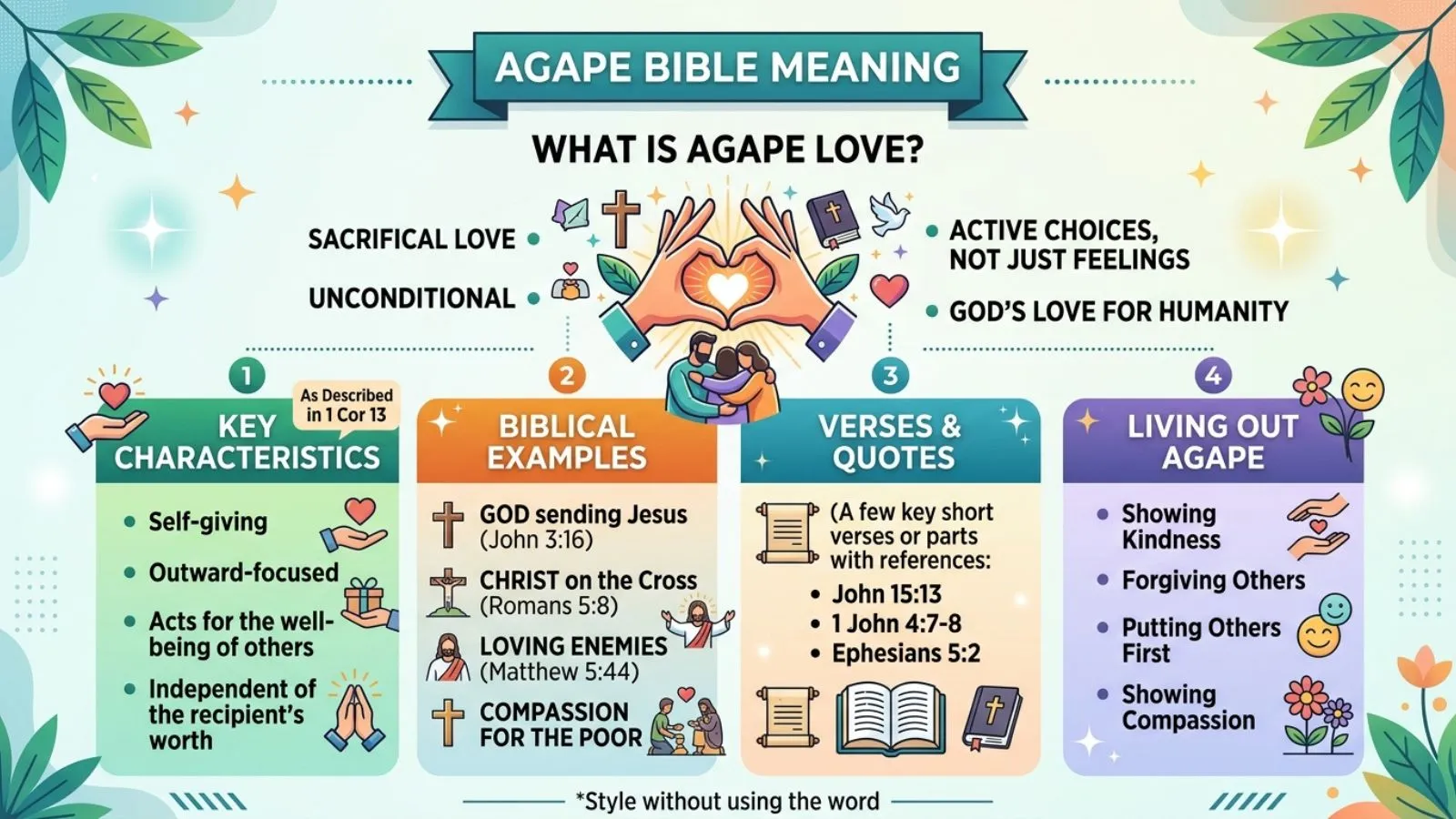
Hey, I want to share something that happened to me recently about Agape Bible Meaning.
I was chatting with a friend when I suddenly saw this term pop up, and honestly, I had no clue what it meant at first.
I kept wondering, “Am I missing something?” It was a bit confusing, and I didn’t want to respond the wrong way.
So, I decided to look into Agape Bible Meaning and understand its true meaning and context.
But what if one simple word could reveal the deepest kind of love described in the Bible?
That question made me even more curious about agape and why this special word is so important in Christian faith.
After learning about it, I realized that agape is more than ordinary love or strong feelings.
It points to selfless, unconditional, and sacrificial love, especially the love God shows toward humanity.
Understanding this biblical term helped me see why it appears in important teachings about loving God and others.
I handled my confusion by learning the proper meaning and biblical context, and now I feel much more confident whenever I come across Agape Bible Meaning in Christian conversations, articles, or social media.
Biblical Meaning of Agape
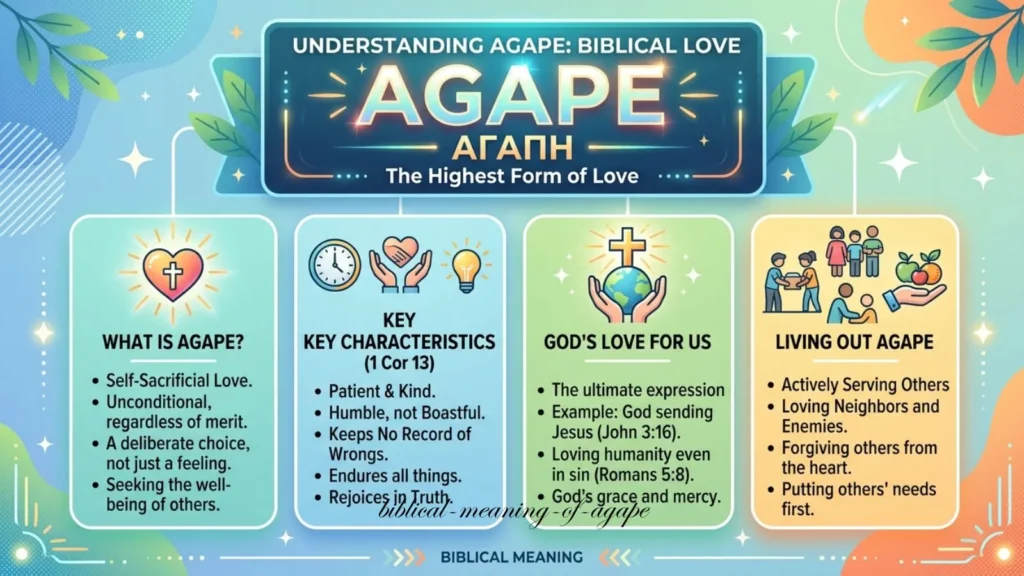
The word agape is commonly used to describe a deep, selfless form of love in the New Testament.
It focuses less on changing emotions and more on a willing choice to love, serve, forgive, and seek what is good.
One of the clearest examples is found in John 3:16:
“For God so loved the world…”
This verse shows the heart of God’s love. God’s love moved Him to give. His love was not passive. It led to action.
This is an important part of the agape Bible meaning: true love gives.
Agape is also beautifully explained in 1 Corinthians 13:4–7. Paul describes love as patient and kind. Love does not envy or boast. It is not selfish and does not keep a record of wrongs.
This passage gives us a practical picture of agape love.
It means loving someone when patience is needed.
It means choosing kindness when anger would be easier.
It means forgiving instead of holding tightly to past pain.
It means caring about another person’s good instead of thinking only about yourself.
Agape Love Reflects God’s Character
The Bible teaches that God is love (1 John 4:8). His love is holy, faithful, and full of grace.
Romans 5:8 gives another powerful picture:
“But God demonstrates his own love for us in this: While we were still sinners, Christ died for us.”
This verse shows that God’s love does not wait for people to become perfect.
He loved us while we were still sinners.
That does not mean God approves of sin. Instead, it shows the depth of His grace. His love reaches people who need forgiveness and transformation.
This is why agape has such a strong place in Christian belief. It points us toward the presence of God, His mercy, and His desire to restore broken hearts.
Agape Is More Than a Feeling
Feelings can change. One day we may feel close to someone, and another day we may feel hurt or distant.
Agape teaches us that love can also involve a choice.
Jesus said in John 13:34–35 that His followers should love one another as He loved them. This kind of love becomes a visible sign of Christian faith.
It can appear in simple ways:
- Forgiving someone who hurt you.
- Helping someone who is struggling.
- Speaking kindly when you feel angry.
- Praying for someone who needs God.
- Showing patience when life becomes difficult.
- Giving without expecting something in return.
Agape does not mean allowing people to harm you or ignoring healthy boundaries. Instead, it means choosing a heart shaped by grace, wisdom, truth, and compassion.
Agape Love and Christian Growth
Agape is also connected with spiritual transformation.
As believers grow in faith, they learn to move beyond self-centered living. They begin to ask, “How can I reflect God’s love here?”
This is not always easy.
Sometimes loving others requires patience. Sometimes it requires forgiveness. Sometimes it means helping someone quietly without receiving recognition.
Jesus gives the greatest example.
His life showed sacrificial love through serving, teaching, forgiving, and ultimately giving Himself for humanity.
That is why agape is not simply a beautiful idea. It is a way of living out faith.
Spiritual Significance and Symbolism of Agape
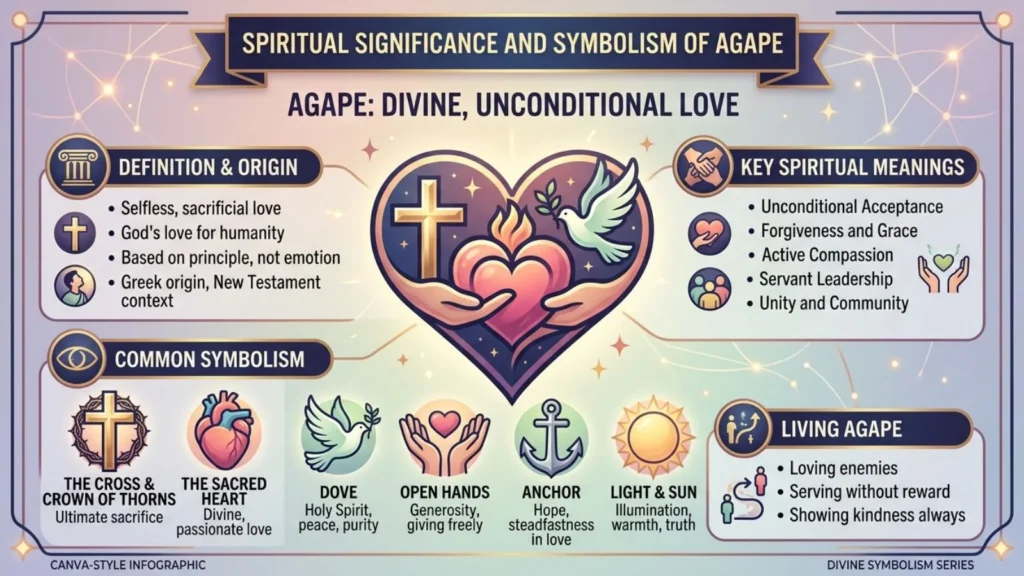
The spiritual symbolism of agape centers on sacrificial love, grace, forgiveness, faithfulness, and spiritual maturity.
When you understand agape, you begin to see love differently.
Love is not only about how someone makes you feel. It is also about how God is shaping your heart.
For example, imagine that someone has disappointed you. Your first reaction may be anger. But after prayer, you may choose to forgive and respond with wisdom instead of revenge.
That moment can become a lesson in agape.
It does not mean pretending the hurt never happened. It means refusing to let bitterness control your heart.
Agape can also bring hope during lonely seasons.
When you feel forgotten by people, remember that God’s love is not dependent on human approval. Scripture repeatedly points believers toward His faithful care.
1 John 4:19 says:
“We love because he first loved us.”
This changes the direction of our spiritual life.
We do not have to create perfect love by ourselves. We first receive God’s love, and then we learn to share that love with others.
Agape can therefore symbolize transformation.
A bitter heart can become forgiving.
A fearful heart can become trusting.
A selfish heart can become generous.
A wounded heart can slowly learn to love again.
Through prayer and faith, God can use these experiences to deepen spiritual growth.
Biblical Interpretations of Agape in Dreams or Real Life
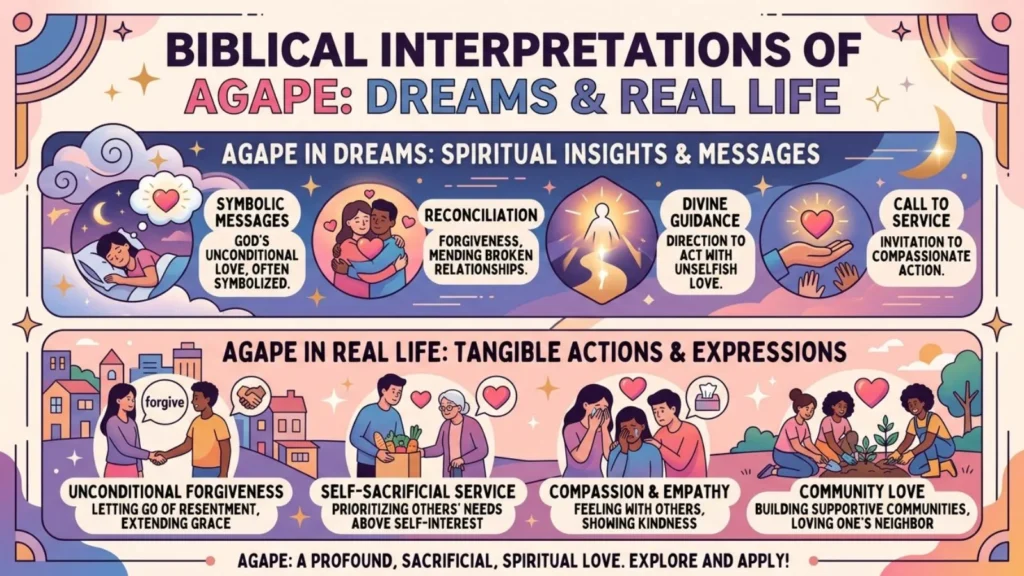
If the idea of agape appears in a dream, prayer, Bible study, or personal reflection, it can be a meaningful reminder to examine your relationships and spiritual life.
A peaceful experience involving love may encourage you to rest in God’s grace and presence.
If you dream about forgiving someone, it may lead you to pray about unresolved hurt. However, Christians should be careful about treating every dream as a direct divine message. The Bible should remain the main guide for understanding spiritual matters.
If agape comes to mind during a difficult relationship, it may remind you to respond with patience, truth, forgiveness, and wisdom.
If you feel unloved or rejected, the message may be even more personal: your worth does not depend completely on human acceptance. God’s love is deeper than changing circumstances.
Take these moments to prayerfully reflect rather than rushing to conclusions.
Ask God for wisdom and allow Scripture to guide your response.
Practical Lessons & Faith of Agape
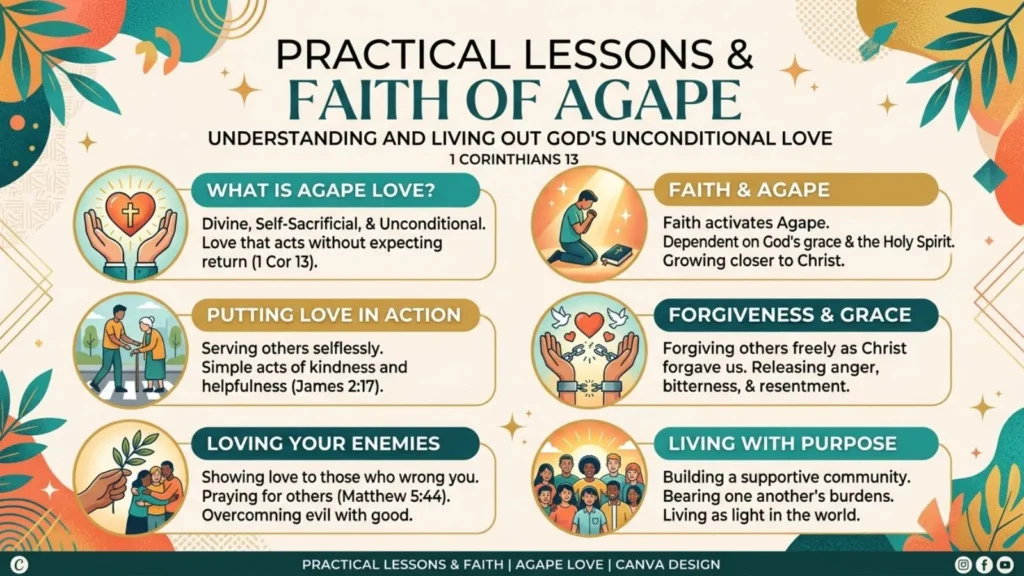
Agape teaches us to love through action, not words alone. Ask God to help you become more patient, forgiving, kind, and generous.
When someone hurts you, pray before reacting. When someone needs help, consider what you can do. When you feel unloved, remember God’s faithful care.
Receive His love first, then let that love shape how you treat others.
Conclusion
The agape Bible meaning points to a love that is selfless, faithful, sacrificial, and rooted in God’s character.
It reminds Christians that real love is more than emotion—it is shown through grace, forgiveness, service, and faithful action.
As you grow in faith, ask God to fill your heart with this kind of love. May His love guide your choices, heal your heart, and help you become a light to others.
Continue Reding:
- Meaning of Wisdom: Godly Wisdom, Faith, and Understanding
- The Meaning of Rest in the Bible: Faith, Peace, and Trust in God
- The Meaning of Zeal in the Bible: Faith, Passion, and Spiritual Fire