Have you ever come across a Bible word that seems simple but holds a much deeper meaning?
A Bible concordance can help you uncover the words, verses, and connections that bring Scripture to life.
I want to share something that happened to me recently about Concordance Bible Meaning.
Chatting with a friend when I suddenly saw this term pop up, and honestly, I had no clue what it meant at first.
I kept wondering, “Am I missing something here?” It was a bit confusing, and I didn’t want to respond the wrong way.
So, I decided to look into Concordance Bible Meaning and understand its meaning and context.
After learning about it, I realized how useful it is for anyone who wants to study the Bible more deeply.
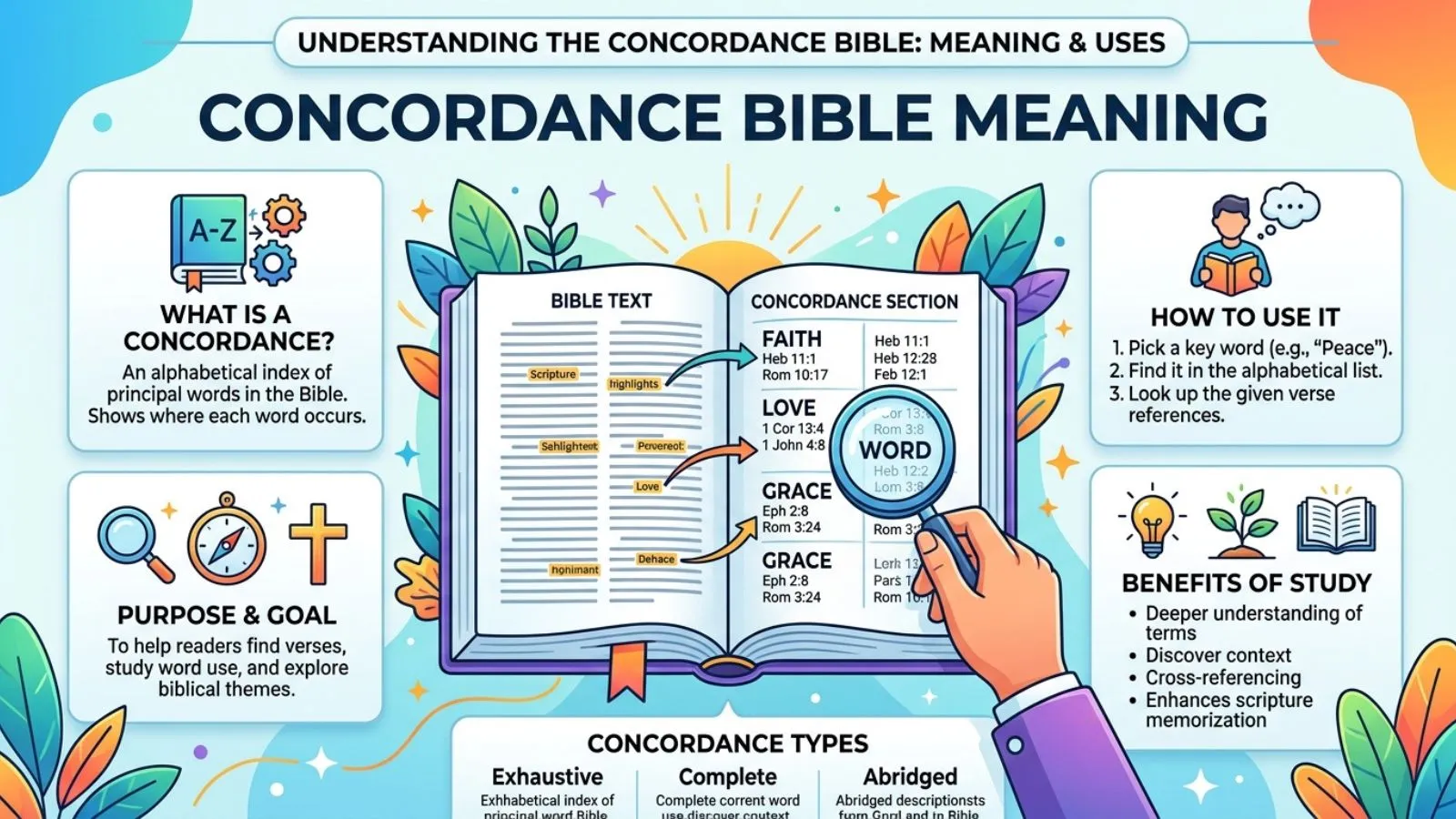
A concordance can help you find where specific words appear in Scripture and understand how they are used in different passages.
Now, whenever I see the term concordance, I feel more confident because I understand its biblical and practical purpose.
Biblical Meaning of a Concordance
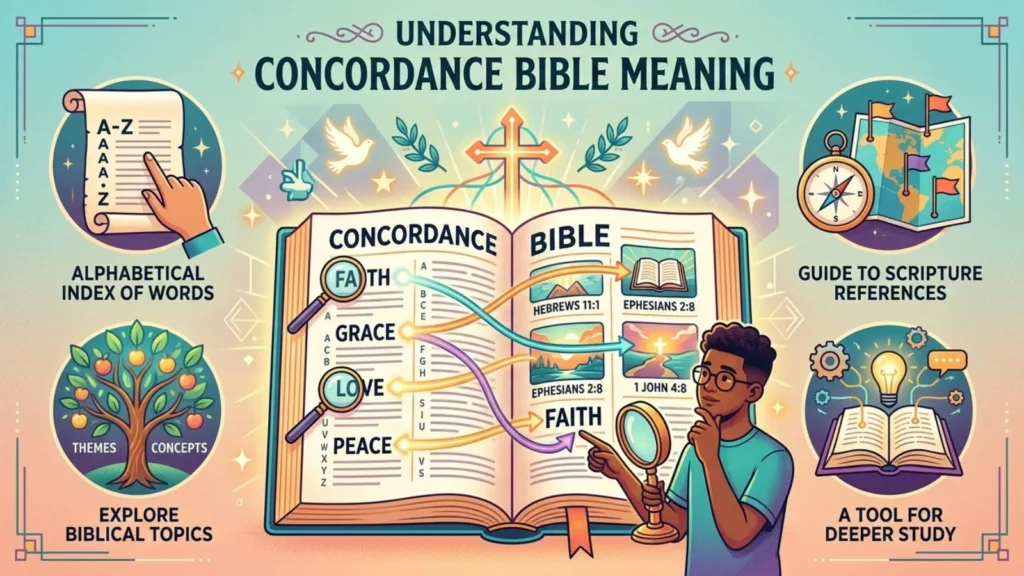
The word concordance is not a special biblical symbol. It is a Bible study term.
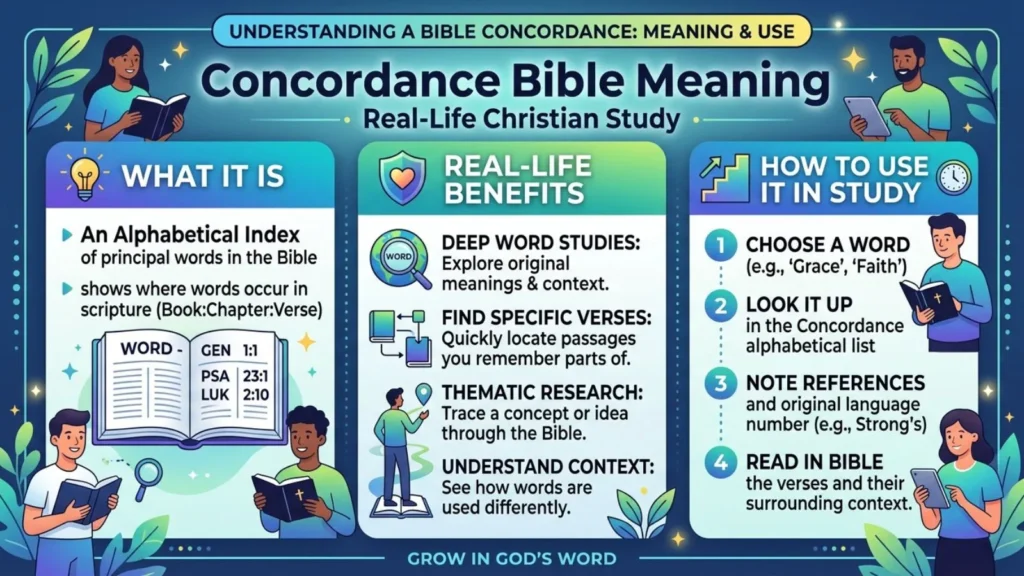
A concordance is designed to help readers find and study words in Scripture. Imagine you want to study the word “hope.” Instead of searching through every page of the Bible, a concordance can show you many passages where that word appears.
You can then read those verses in their full context.
This matters because a single word may be used in different ways. The meaning of a word can depend on the sentence, the writer, the situation, and the original biblical language.
A Concordance Helps You Find Bible Verses
One of the main purposes of a concordance is simple: finding Scripture.
For example, if you want Bible verses about peace, you can search for “peace.” The concordance may give you references to passages such as John 14:27, Philippians 4:6–7, and Isaiah 26:3.
Reading these verses together can help you see a broader biblical picture.
Instead of focusing on one verse alone, you begin to notice how Scripture speaks about the same idea in different places.
A Concordance Helps With Word Studies
A concordance can also help you understand an important biblical word.
For example, the New Testament was written primarily in Greek. The Old Testament was written mainly in Hebrew, with some Aramaic.
Some detailed concordances connect English words with their original Hebrew or Greek terms. This can help readers explore how a word was used in its original setting.
However, this information should be used carefully. A Hebrew or Greek word does not automatically have every possible meaning in every verse. Context still matters.
A Concordance Supports Careful Bible Study
The Bible says in Acts 17:11 that the Bereans examined the Scriptures to see whether what they heard was true.
Their example shows the value of checking God’s Word carefully.
A concordance can support this habit. If someone teaches that a certain biblical word has a particular meaning, you can search Scripture and examine the passages yourself.
This encourages wisdom, discernment, and personal Bible study.
Spiritual Significance of Using a Bible Concordance
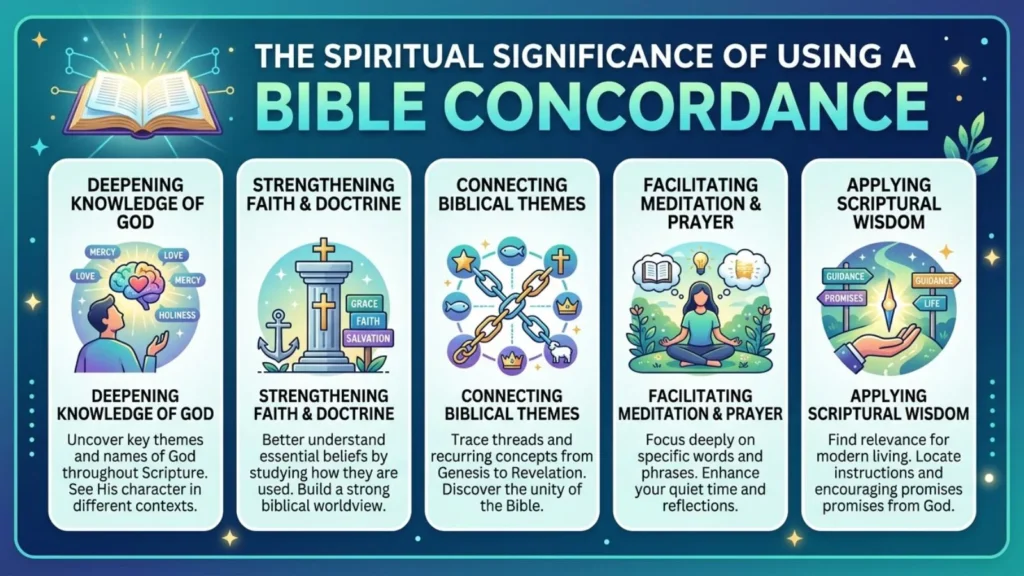
A concordance itself does not carry a supernatural message. Its spiritual value comes from how it helps you study and understand God’s Word.
It Can Lead You Toward Deeper Understanding
Sometimes one verse answers a question. Other times, you need to see several passages before the message becomes clear.
A concordance can help you trace a theme through Scripture.
For example, someone struggling with fear might search for verses about fear, courage, trust, and God’s presence. As they read, they may discover repeated biblical truths about trusting God during difficult seasons.
This can bring comfort and hope.
It Encourages Spiritual Growth
Christian growth takes time.
Reading Scripture regularly helps shape the heart and mind. A concordance can make that study more focused.
You might choose one word each week, such as:
- Faith
- Grace
- Forgiveness
- Wisdom
- Hope
- Love
- Obedience
Then you can study how Scripture presents that subject.
This simple habit can turn Bible reading into deeper spiritual reflection.
It Can Help You Connect Bible Verses
The Bible contains many connected themes.
For example, the idea of faith appears throughout both the Old and New Testaments. By studying related passages, you can see how different biblical writers speak about trusting God.
This does not mean every verse says exactly the same thing. Instead, careful study helps you understand the different ways Scripture develops a theme.
That can strengthen your Christian belief and faith.
How to Use a Concordance in Bible Study
Using a concordance does not need to be complicated.
1. Choose a Word
Start with a word that interests you.
For example, perhaps you are studying hope.
2. Search for the Word
Look up “hope” in a concordance. You will find Bible references connected to that word.
3. Read the Full Verses
Do not read only the single line containing the word.
Read the surrounding verses. Context helps you understand what the writer actually meant.
4. Compare Different Passages
Look at several verses together.
Ask:
What does Scripture consistently teach about this subject?
5. Pray for Understanding
Bible study is more than collecting information.
Before and during your study, pray for wisdom and understanding.
Psalm 119:18 expresses this desire: “Open thou mine eyes, that I may behold wondrous things out of thy law.”
Prayer keeps Bible study focused on knowing God rather than simply gaining knowledge.
Concordance Bible Meaning in Real-Life Christian Study
Imagine you are going through a difficult season.
You feel uncertain about tomorrow, so you decide to study the word trust.
You search for the word in a concordance and find several passages , read Proverbs 3:5–6, where believers are encouraged to trust in the Lord rather than depend only on their own understanding.
Then you read other passages about God’s faithfulness.
The concordance did not give you a personal prophecy.
Instead, it helped you find biblical truth that you could meditate on and apply to your life.
This is an important distinction.
A concordance should not be treated as a fortune-telling tool. It helps you explore what the Bible says. God’s Word remains the foundation.
Does a Concordance Reveal God’s Message?
A concordance can help you discover biblical teachings, but it should not be viewed as a magical way to receive a private message from God.
For example, opening a concordance randomly and choosing a word should not replace prayerful Bible reading.
Instead, use it with wisdom.
Read Scripture in context. Consider the purpose of the passage. Compare translations when helpful. Look at the historical and literary setting. Most importantly, keep your study centered on the message of Scripture.
The Holy Spirit guides believers into truth, while Bible study tools can help organize and explore the biblical text.
Practical Faith Lessons From Bible Concordance Study
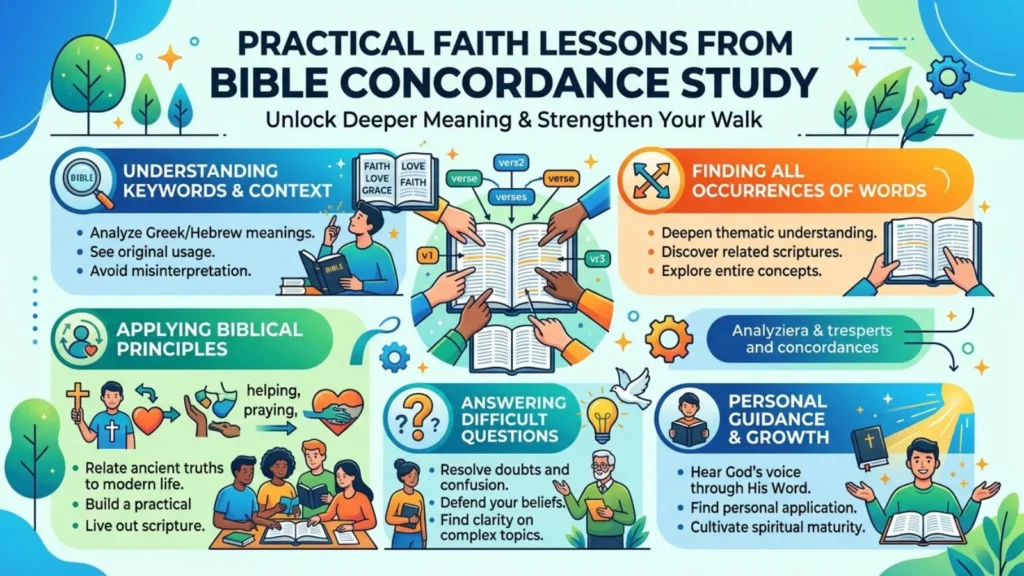
A concordance teaches us something valuable about spiritual growth: understanding often requires patience.
You may not understand a verse immediately. That is okay.
Take time to search, read, pray, and reflect. Do not rush God’s Word.
When you study a biblical word, ask how it points you toward faith, obedience, love, wisdom, hope, and a closer relationship with God.
Let Scripture shape your heart, not simply your knowledge.
Conclusion
The concordance Bible meaning is simple: a concordance is a Bible study tool that helps you find words, compare passages, and explore biblical themes.
It can deepen your understanding of Scripture and support prayerful Christian growth. But the concordance itself is not the message. God’s Word is the foundation.
As you study, pray for wisdom, read with an open heart, and trust God to guide you. May every page of Scripture lead you closer to His truth, peace, and hope.
Continue Reding:
- Number 888 in the Bible: Meaning, Symbolism, and Spiritual Lessons
- Rebecca Biblical Meaning: Her Name, Story, Faith, and God’s Purpose
- Green Meaning in the Bible: Symbolism, Faith, Growth, and Hope