Have you ever come across a Bible term that seems simple at first but carries a much deeper meaning?
Moab is one of those names, connected to family history, conflict, redemption, and God’s greater plan.
I was chatting with a friend when I suddenly saw the term “Moab” pop up, and honestly, I had no clue what it meant at first.
I kept wondering, “Am I missing something here?” It was a bit confusing, and I didn’t want to understand it the wrong way.
So, I decided to look into the Moab Bible meaning and learn more about its biblical history and spiritual context.
After understanding it, I realized that Moab is not just the name of an ancient nation—it has an important place in the Bible and carries lessons about human choices, pride, judgment, mercy, and God’s faithfulness.
Now, whenever I come across Moab in Scripture, I feel more confident understanding what it means and why it matters.
Biblical Meaning of Moab
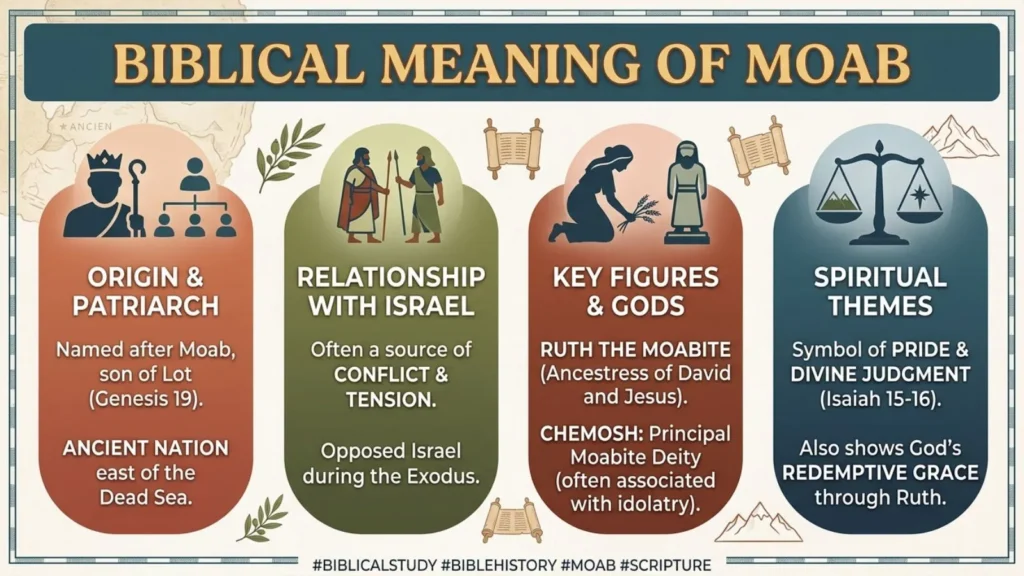
The name Moab is traditionally connected with the Hebrew expression meaning “from father.” Genesis 19:37 connects Moab with Lot and his older daughter.
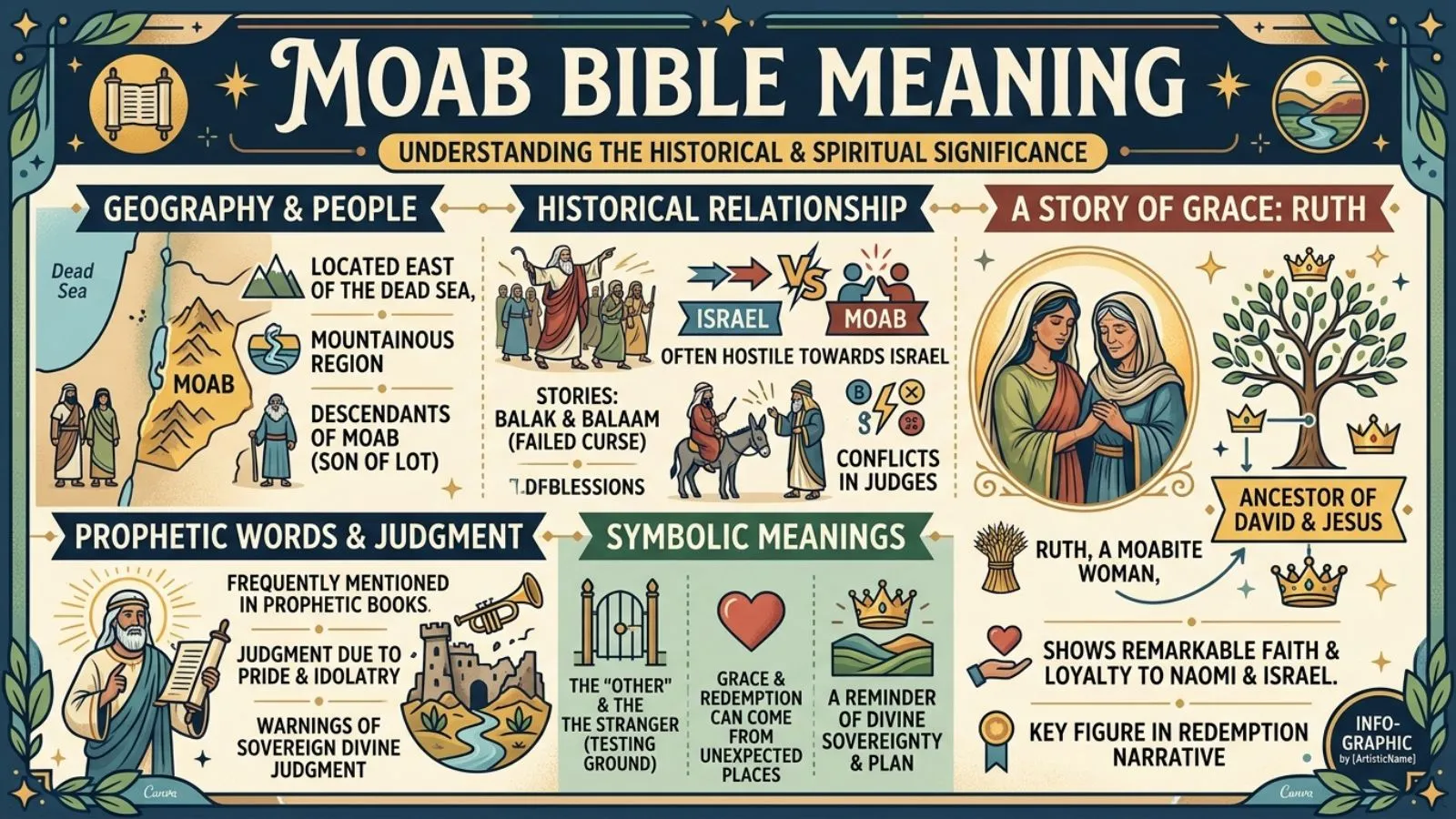
Moab was not originally the name of a place. It became the name of a people and later their land. The Moabites lived east of the Dead Sea, near the territory of Israel.
The Bible gives us a detailed picture of this nation. Sometimes Moab appears as an enemy of Israel. At other times, the relationship is more complex.
This makes Moab an important example of how biblical symbolism cannot always be reduced to one simple meaning.
Moab and Family History
The first important lesson of Moab is connected with family and human choices.
Lot was Abraham’s nephew. His descendants became the Moabites and Ammonites. This means the people of Moab had a family connection to the people of Israel.
Deuteronomy 2:9 shows that God gave the descendants of Moab their land and instructed Israel not to take it from them.
This is important because it shows that God remained sovereign even over nations that were not part of Israel’s covenant community.
God knew the boundaries and future of Moab. Nothing was outside His awareness.
Moab and Conflict With Israel
Moab later became involved in conflict with Israel.
In Numbers 22–24, Balak, king of Moab, became afraid when he saw the Israelites approaching. He called Balaam to curse Israel. Yet God did not allow Balaam to speak a curse over His people.
Instead, blessings came from Balaam’s mouth.
This story carries a powerful spiritual message: what God has chosen to bless cannot be overturned by human fear or opposition.
Balak was afraid of Israel’s future. His fear led him to seek a spiritual solution against God’s people. But God remained in control.
For believers, this can be a reminder not to let fear control their decisions. When life feels uncertain, God’s authority is greater than human opposition.
Moab, Temptation, and Spiritual Danger
Moab also appears in a warning story in Numbers 25. Some Israelites became involved with Moabite women and were drawn into worship of Baal of Peor.
This event shows another side of Moab’s biblical symbolism: spiritual compromise.
The danger was not simply that the Israelites were near another nation. The deeper problem was that they turned away from God.
This gives Christians an important lesson. Sometimes the greatest spiritual danger is not an obvious attack. It can be a gradual movement away from God’s truth.
A small compromise can slowly become a larger problem.
Moab and Pride
The prophets also speak strongly against Moab.
Isaiah 16 and Jeremiah 48 describe Moab’s pride, judgment, and downfall. Jeremiah 48:29 repeatedly highlights Moab’s pride and self-confidence.
This gives Moab another biblical theme: pride can lead a person away from God.
Moab’s story reminds us that strength, wealth, position, or national power cannot replace humility before God.
Yet biblical judgment should not make us forget God’s wider message of mercy. Scripture continually shows that God is both righteous and compassionate.
Ruth: A Moabite Woman Who Found Redemption
Perhaps the most beautiful part of Moab’s biblical story is Ruth.
Ruth was a Moabite woman who married into an Israelite family. After becoming a widow, she chose to stay with Naomi and return to Bethlehem.
Her famous words in Ruth 1:16 show her deep commitment:
“Your people shall be my people, and your God my God.”
Ruth’s story changes the way we view Moab.
She came from a people with a troubled history, yet she became part of God’s redemptive story. Ruth married Boaz and became the great-grandmother of King David (Ruth 4:17).
Matthew 1:5 later places Ruth in the genealogy of Jesus Christ.
This is one of the strongest spiritual lessons connected with Moab:
Your background does not have to determine your future with God.
Ruth’s story shows that faith, loyalty, humility, and obedience can lead a person into a beautiful new chapter.
Spiritual Significance and Symbolism of Moab
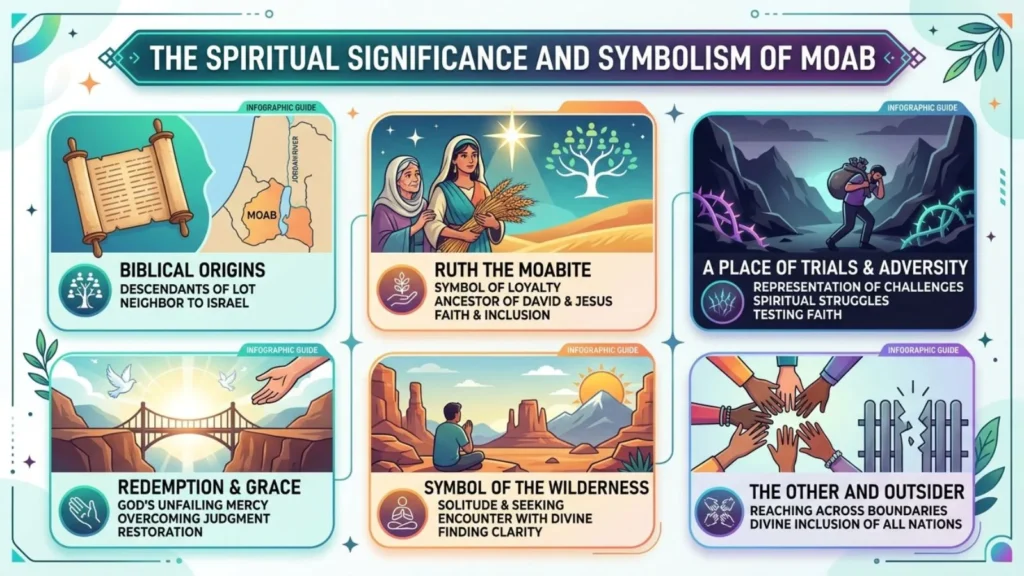
The spiritual meaning of Moab is best understood through the many lessons found in its biblical story.
1. Moab Can Represent a Complicated Past
Moab began through a deeply broken family situation. Yet God did not stop working through the generations that followed.
This can encourage anyone who feels troubled by their past.
Perhaps you have family mistakes, painful memories, or choices you wish you could change. Moab reminds us that God can work through broken histories.
Your past may explain where you came from, but it does not have to decide where you are going.
2. Moab Can Warn Against Spiritual Compromise
The events of Numbers 25 remind us to guard our hearts.
Faith can become weak when we repeatedly accept things that pull us away from God.
This does not mean living in fear. It means staying close to God’s Word, praying regularly, and being wise about the influences around us.
Spiritual strength grows when we choose God again and again.
3. Moab Can Teach Humility
The prophets’ warnings against Moab show the danger of pride.
Sometimes people feel secure because of money, success, relationships, knowledge, or position. But these things can change.
God calls His people to walk with humility.
Micah 6:8 gives a simple picture of faithful living: do justice, love kindness, and walk humbly with God.
4. Ruth Shows That God Can Bring Redemption
Ruth is perhaps the greatest hope-filled lesson connected with Moab.
She was a foreign woman from Moab, yet God placed her inside the family line that led to David and ultimately to Christ.
Her story shows transformation, grace, belonging, and hope.
If you feel like an outsider, Ruth’s story can remind you that God’s grace reaches people from unexpected places.
Biblical Interpretations of Moab in Dreams or Real Life
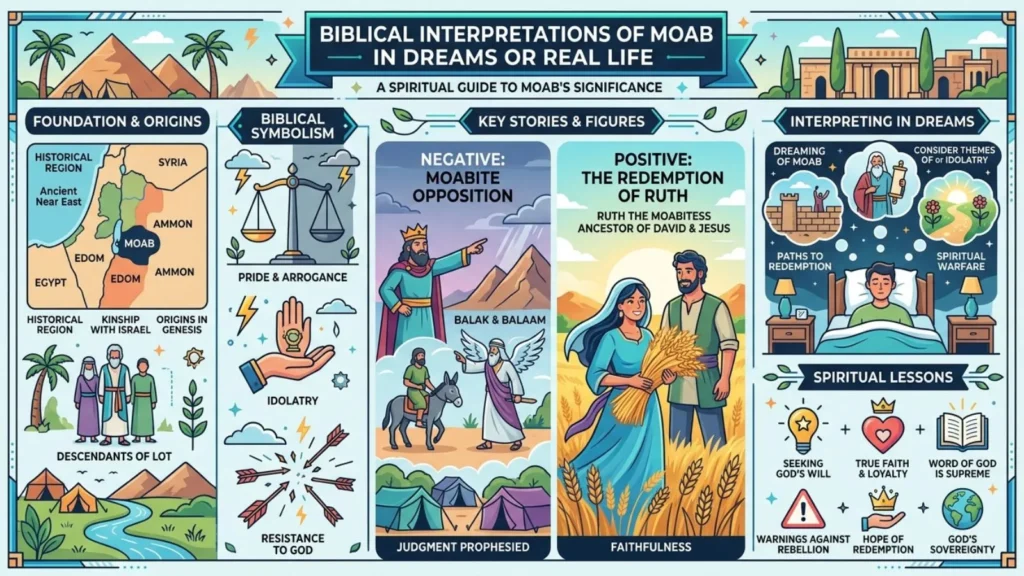
If Moab appears in a dream, Bible study, or personal reflection, it is wise not to assume that it automatically carries one fixed meaning.
The Bible does not teach that every dream symbol has a universal interpretation.
Instead, consider the context, Scripture, prayer, and your current spiritual journey.
If Moab appears in a peaceful setting, it may lead you to reflect on Ruth, redemption, family, or God’s ability to create something beautiful from a difficult past.
Moab appears in a fearful or hostile setting, it may remind you of conflict, temptation, pride, or spiritual compromise.
If you repeatedly think about Moab while praying, ask God for wisdom rather than rushing to a conclusion.
James 1:5 reminds believers that God gives wisdom generously to those who ask Him.
The safest approach to biblical dream interpretation is to keep Scripture above personal symbolism and seek God’s guidance with a humble heart.
Practical Lessons and Faith of moab
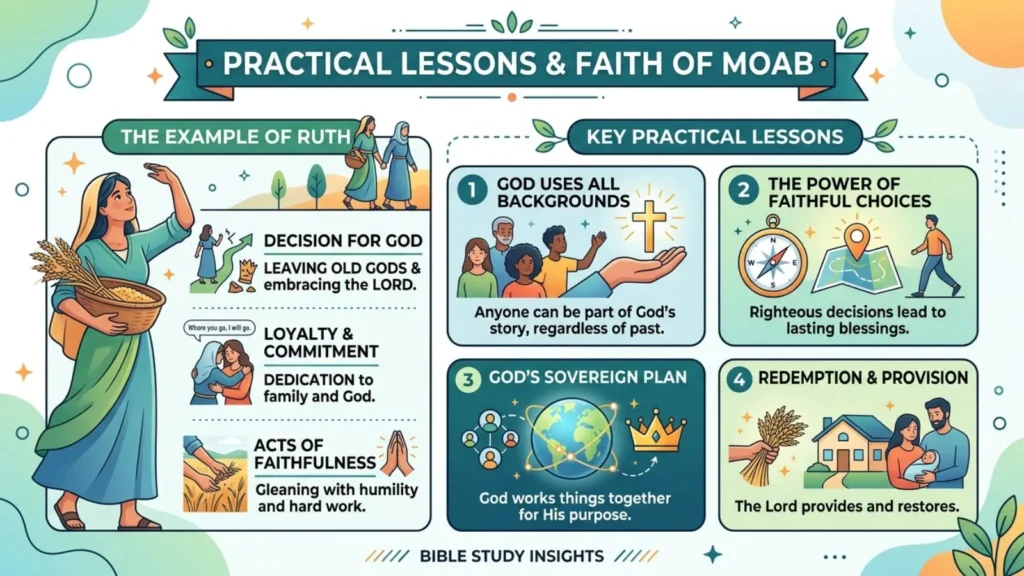
Moab teaches us to look beyond appearances. A difficult beginning does not mean a hopeless ending. Ruth’s life proves that God can bring redemption from unexpected places.
When you think about Moab, reflect on your own journey. Are you holding onto your past , temptation? Are you trusting yourself too much?
Bring these questions to God through prayer, Scripture, humility, and faith.
Conclusion
The Moab Bible meaning carries several powerful themes: family history, conflict, temptation, pride, redemption, and hope.
While Moab sometimes represents spiritual danger and judgment, Ruth shows that God can bring extraordinary redemption from an unexpected background.
The story of Moab reminds us that God sees the whole journey, not only the beginning.
Trust Him with your past, your present, and your future, and let His grace lead you toward hope.
Continue Reding:
- Daniel in the Bible Meaning: Faith, Wisdom, and God’s Protection
- Caleb in the Bible Meaning: Courage, Faith, Perseverance, and God’s Reward
- Concordance Bible Meaning: Definition, Purpose, and Biblical Significance